Do You Actually Need a Short Sale? How Sacramento Homeowners Can Run the Numbers
Not necessarily. Owing more than your home's estimated market value does not, by itself, determine whether you need a short sale. The correct test is a calculation: take the expected sale price, subtract the estimated selling expenses, then subtract every mortgage and lien payoff that must be resolved through closing. If something is left over, you have proceeds. If the numbers fall short, you have a shortage, and a short sale becomes worth evaluating. Lender qualification is separate, and it is investor-specific and loan-program-specific.
By Gary Lee, REALTOR | Founder and Lead Short Sale Negotiator | California DRE #01448722
Gary Lee has worked with homeowners in mortgage default since 2007, has experience involving hundreds of properties in mortgage default, has been a licensed California REALTOR for more than 20 years, completed CDPE coursework in 2009, and founded both SacramentoShortSale.com and ShortSaleDealMaker.com.
The Short Answer: Run the Numbers Before You Label Anything
Owing more than the home's value is one sign that a short sale may need to be evaluated, but it is not the complete test. First determine whether the mortgage is underwater by comparing the home's estimated market value with the mortgage debt. Then calculate whether a normal sale can close by subtracting estimated selling expenses and required lien payoffs from the expected sale price. If the result is negative, the seller must either bring sufficient funds to close, resolve the shortage another way, or obtain approval from one or more secured creditors to accept less than the full amount owed.
I have worked with homeowners in mortgage default since 2007, and the most common source of confusion is the word "underwater." Being underwater is a market condition. Whether you need a short sale is a math and documentation question, and it deserves an answer built from real numbers, not from a website's estimate.
| Calculation | Formula | What it answers |
|---|---|---|
| Basic mortgage equity | Estimated market value minus mortgage balances | Is the mortgage technically underwater? |
| Estimated normal-sale proceeds | Expected sale price minus selling expenses and required payoffs | Can a normal sale close without additional funds? |
| Estimated shortage | Required expenses and payoffs minus available sale proceeds | How large is the potential closing gap? |
These calculations are preliminary estimates. They do not establish lender approval, a deficiency result, tax treatment or foreclosure postponement.
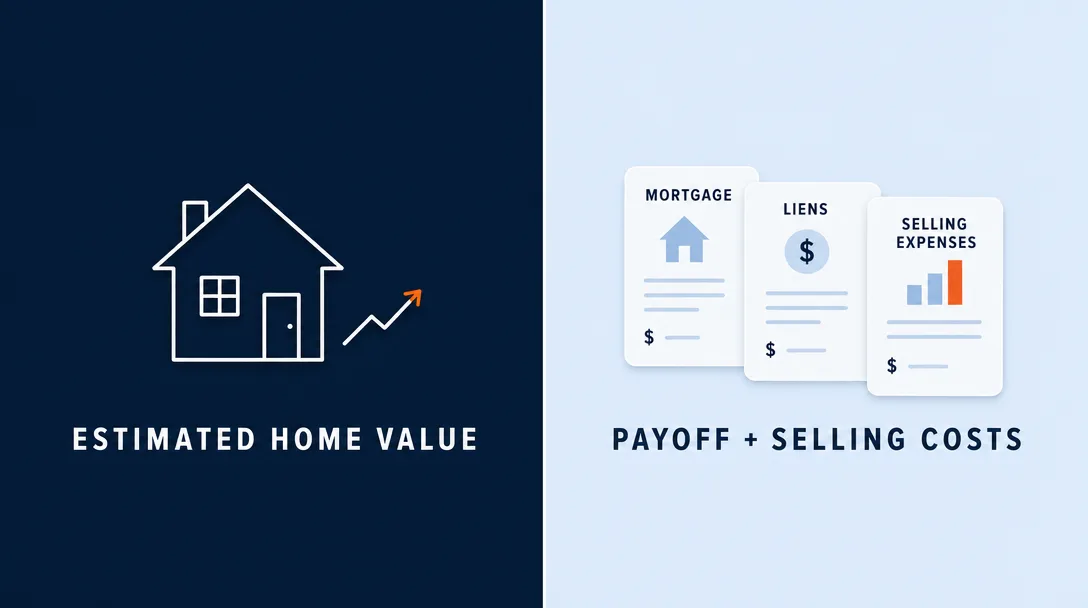
Market Value Is Not the Same as Net Proceeds
Start with the number that actually matters. Your home's estimated market value is what a buyer might pay for the property. Your net proceeds are what is left after the sale's expenses and after every payoff that must be cleared. The second number, not the first, is the one that tells you whether you have room to work with.
An automated home-value estimate is a useful starting point, nothing more. It is not a comparative market analysis, and it is not what a lender uses to judge a short-sale file. Lenders test value through their own appraisal or broker price opinion process. For your own decision, get a current value opinion from an experienced local agent who knows your neighborhood, then test it against payoffs and expenses. The BPO and valuation guide in the Short Sale Knowledge Center explains how that value test actually works.
Mortgage Statement Balance Versus Actual Payoff
Your monthly statement balance is not your payoff. The statement shows what was owed as of a cutoff date. The payoff is the precise amount required to fully satisfy the loan on a specific closing date, and the two can differ.
Payoff amounts include the remaining principal plus interest that accrues each day the loan is open, and they can shift depending on when the loan is actually paid. The only number worth planning around is a written payoff statement from your servicer, and that statement should be requested with a target payoff date close to your expected closing. Never run this test with a balance from an old statement.
Accrued Interest, Late Charges and Foreclosure Expenses
If you are behind on payments, the amount you owe keeps growing. Interest keeps accruing, and late charges, delinquency fees, and in some situations foreclosure-related expenses can be added to the balance.
This matters twice. First, the longer the process runs, the larger the number a lender or investor must approve. Second, whether those extra charges are covered in a short sale is decided by the servicer and the investor, not assumed. Get current payoff figures that include what has accrued, and understand where the default is adding cost.
First Mortgage, Second Mortgage and HELOC Balances
Every loan is its own separate number, and every lienholder has to be addressed. A first mortgage, a second mortgage, and a home equity line of credit are three different debts with three different payoffs, and each lender or investor reviews the file through its own lens.
A HELOC can also carry a balance even if you have not used it recently. The drawn balance, not the credit limit, is what counts, and it belongs in the same calculation as everything else. When a second lien can change the whole shape of a transaction, the junior liens and HELOCs guide walks through how these holders behave.
Property Taxes, HOA Claims, Judgments and Other Liens
Mortgages are not the only claims against the property. Property taxes that are due, HOA assessments including delinquencies, recorded judgments, child or spousal support liens, and mechanic's liens can all attach to the title. Lien priority and the amounts that must be paid at closing depend on the type of lien, recording history, applicable law, title requirements, payoff demands and the lender-approved settlement statement. Property taxes and certain assessments can receive special treatment, but homeowners should not attempt to determine legal lien priority merely from the type of debt. A current title report and professional review are required.
A title search reveals what is actually recorded. If any of these exist, they belong in the calculation, because they are part of what must be resolved to deliver clear title to a buyer. The HOA liens and title problems guide covers the ones that most often stall a file.
Solar Obligations, PACE Assessments and Down-Payment-Assistance Loans
Solar and energy-efficiency improvements add a layer many homeowners forget. A solar lease or power-purchase agreement may require assumption, transfer, buyout or another program-specific resolution. It should not automatically be treated as a mortgage payoff. In California, a PACE obligation is generally collected through the property-tax system and may require payoff or another approved resolution depending on title, buyer financing and program requirements. PACE structures and priority rules vary outside California.
Down-payment-assistance loans are often recorded as second mortgages with their own payoff and their own approval requirements. None of these disappear because the property is underwater; they all sit in the same stack of numbers you are adding up.
Estimated Commissions and Customary Closing Expenses
Selling a home is never just the sale price. Commissions, escrow fees, title insurance, transfer taxes, and recording fees all come out of the transaction, and in a short sale the lender or investor reviews these charges as part of the approval.
Commissions remain negotiable, and in many completed short sales, approved commissions and customary seller closing costs are paid through the transaction proceeds. Approval of those charges is lender- and investor-specific, and no professional should promise that every expense will be accepted. Understand the expense side before you run the math, because it is a real subtraction from the sale price. The short-sale closing checklist shows how approved expenses and payoffs actually flow at closing.
A Simple Homeowner Short-Sale Calculation
Here is the whole test on one piece of paper: expected sale price, minus estimated selling expenses, minus mortgage and lien payoffs, equals estimated seller proceeds or estimated shortage. Everything above this point is just gathering the inputs for that one line.
Hypothetical illustration, round numbers
-
Expected sale price: $450,000
-
Minus estimated selling expenses: $40,000 (commission, escrow, title, transfer and related costs)
-
Minus mortgage and lien payoffs: $440,000 (first mortgage payoff plus a second mortgage and accrued costs)
-
Equals estimated seller proceeds or estimated shortage: a $30,000 estimated shortage
In this illustration, expected net proceeds of about $410,000 would not cover the $440,000 in payoffs, so the sale would leave an estimated shortage of about $30,000. That is the size of the shortfall a lender or investor would be asked to approve in a short sale.
This is a hypothetical illustration only. It is not a quote, a comparative market analysis, an appraisal, a settlement statement, or a lender approval. Your actual numbers will differ, and no outcome can be guaranteed.
A negative result does not automatically require a short sale. If the homeowner can and chooses to bring enough money to satisfy the required payoffs and expenses, the transaction may still close as a regular sale. A short sale is needed when the transaction cannot otherwise produce enough money to satisfy a secured creditor and that creditor is being asked to accept less than the amount owed. Because this is a California article, do not confuse voluntarily bringing funds to complete a full-payoff regular sale with a lender requiring additional borrower compensation in exchange for short-sale consent under CCP §580e(b).
What this calculation does not answer
A shortage calculation identifies a potential financial gap. It does not determine whether a lender will approve a short sale, whether California's anti-deficiency protection applies, whether a particular lien will be released, whether canceled debt will be taxable, or whether a scheduled foreclosure will be postponed. Those questions require separate review of the loan, approval documents, applicable law and the homeowner's circumstances. See the California short-sale deficiency article and the Short Sale Taxes in 2026 article.
A consumer-facing automated home-value estimate does not establish short-sale eligibility. The servicer or investor may obtain its own appraisal, broker price opinion, automated valuation, desktop analysis or other approved valuation. The controlling value for lender review is determined under the applicable investor and servicer process—not by a public home-value website.
Traditional Sale, Borderline Sale and Likely Short-Sale Examples
Once you run the calculation, most situations land in one of three buckets.
-
Traditional sale. Expected net proceeds clearly exceed every payoff and expense. A regular sale works, no lender approval is needed, and the goal is simply to sell at the best price in a reasonable time.
-
Borderline sale. Estimated proceeds are close enough to required payoffs and expenses that ordinary changes in price, payoff figures, prorations, repairs, credits or closing costs could create a shortage. There is no universal percentage that defines this category.
-
Likely short sale. Expected net proceeds clearly fall short of the payoffs. This is where a short sale becomes the realistic path to evaluate, because one or more lienholders will be asked to accept less than the full amount owed.
No bucket is automatic, and no one should tell you that a short sale is definitely the answer before the numbers are actually run. The point of the exercise is to know which bucket you are in before you make promises or miss a deadline.
Why Lender Qualification Depends on the Investor, Loan Program and Borrower's Circumstances
Here is the part that surprises people. Running the numbers tells you whether a shortage exists, but qualifying for a short sale is a separate question, and the lender answers it.
A servicer does not approve a short sale simply because a home is underwater. It reviews the seller's documented hardship, the property value, the loan program, and the investor's guidelines. FHA, VA, Fannie Mae, Freddie Mac, conventional, and portfolio loans each follow different rules and different timelines, and the lender and servicer hub maps those differences. Hardship is documented, not assumed, and the hardship packages guide shows what a credible package looks like.
FHA, for example, has its own Pre-Foreclosure Sale requirements. The HUD FHA loss-mitigation guidance explains the current FHA home-disposition options.
So the math tells you which direction you are heading. The hardship story and the loan type tell you whether the lender will move with you. For California homeowners, the California short-sale representation page explains how The Gary Lee Team can handle the file directly.
Do Not Intentionally Stop Making Payments Based on an Internet Article
I want to be direct with you. Do not stop making your mortgage payments because of anything you read here. Stopping payments has real consequences: late charges, negative credit reporting, a possible notice of default, and eventually the risk of foreclosure.
A short sale is usually started because a hardship already exists, not because someone stopped paying to create one. Payment decisions belong in a conversation with your servicer and a qualified professional who knows your full financial picture. No website, including this one, can responsibly tell you to stop paying.
The Information Needed for a Confidential Preliminary Review
If you want an honest answer about whether you need a short sale, bring these to the conversation:
-
Estimated property value and where that estimate came from.
-
Payoff estimates for every mortgage and lien.
-
Current delinquency status and how many payments you are behind.
-
Any Notice of Default or scheduled trustee-sale date.
-
Loan types and which investors hold them.
-
Any second mortgage, HELOC, judgment, HOA claim, solar, or PACE obligation.
-
How much time you have before any deadline.
With those in hand, an experienced team can tell you whether the numbers point to a traditional sale, a short sale, or a situation that needs a different professional.
Foreclosure timing
Listing the property, submitting a short-sale package or receiving an offer does not by itself guarantee that a Notice of Default or scheduled trustee's sale will be postponed. Homeowners facing a foreclosure deadline should obtain the current sale date and confirm any postponement directly through the appropriate servicer, trustee and qualified professional.
Underwater Mortgage and Short-Sale FAQs
How do I know if I am underwater on my Sacramento mortgage?
Underwater and unable to close normally are related, but they are not identical. A mortgage is commonly described as underwater when the mortgage debt exceeds the home's current market value. A homeowner may also be unable to complete a normal sale even when the mortgage is not technically underwater, because commissions, escrow, title charges, taxes, HOA claims or other liens consume the remaining equity. The practical short-sale test therefore goes beyond the basic underwater calculation. It asks whether the expected sale proceeds will be sufficient to pay all required selling expenses and secured obligations at closing.
Does owing more than my home is worth mean I need a short sale?
Not by itself. Owing more than your estimated market value is a market condition, and it does not automatically determine whether a short sale is required. A negative result does not automatically require a short sale: if the homeowner can and chooses to bring enough money to satisfy the required payoffs and expenses, the transaction may still close as a regular sale. A short sale is needed when the transaction cannot otherwise produce enough money to satisfy a secured creditor and that creditor is being asked to accept less than the amount owed.
What is the difference between my mortgage statement balance and my actual payoff?
Your statement balance is what was owed as of a cutoff date. Your payoff is the precise amount required to fully satisfy the loan on a specific future closing date, and it includes interest that accrues each day, plus any applicable fees. For planning, use a written payoff statement from your servicer dated close to your expected closing, not a monthly statement.
How do I run the short-sale calculation myself?
Write down your expected sale price, subtract your estimated selling expenses such as commission, escrow, title, and transfer costs, then subtract the payoffs of every mortgage and lien. What is left is estimated seller proceeds. If the number is negative, you have an estimated shortage, which is the amount a lender or investor would be asked to approve in a short sale.
Do automated home-value estimates prove short-sale eligibility?
A consumer-facing automated home-value estimate does not establish short-sale eligibility. The servicer or investor may obtain its own appraisal, broker price opinion, automated valuation, desktop analysis or other approved valuation. The controlling value for lender review is determined under the applicable investor and servicer process—not by a public home-value website.
Can I sell my Sacramento home for less than I owe without lender approval?
No. If the sale proceeds are not enough to pay off every lien, each lienholder whose debt will not be fully paid must approve accepting less, or the sale cannot close. A short sale is the transaction where those approvals are requested. Without them, the property generally cannot transfer free of the existing liens.
Should I stop making mortgage payments to force a short sale?
No. Do not stop making payments based on an internet article, including this one. Stopping payments has real consequences, including late charges, negative credit reporting, a possible notice of default, and the risk of foreclosure. Payment decisions belong in a conversation with your servicer and a qualified professional who knows your full financial picture.
Last reviewed and updated: September 2026