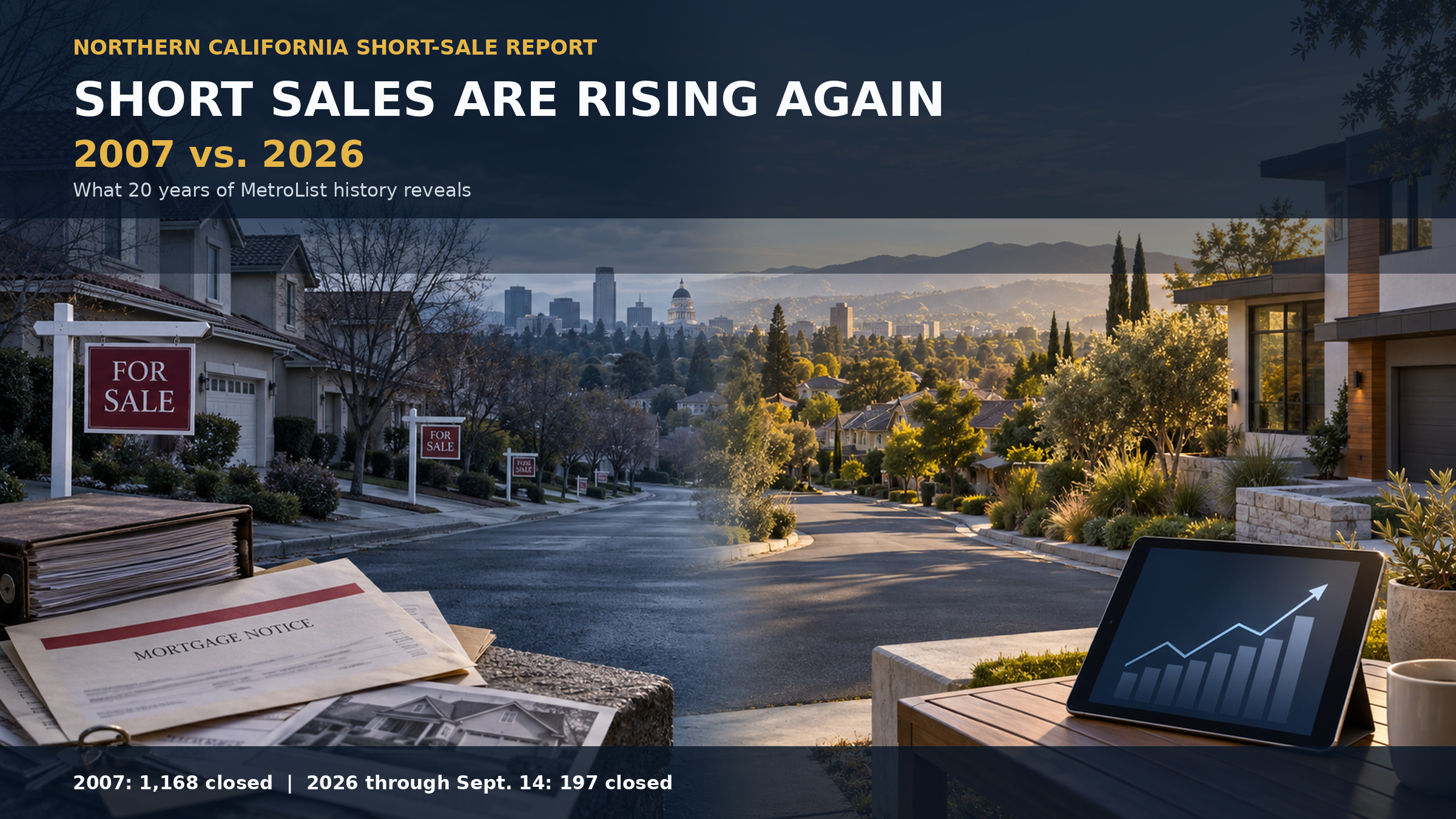
Short Sales Are Rising in Northern California: Are We Heading Back to 2007?
MetroList short-sale closings have nearly doubled since 2023 and already surpassed the entire 2025 total. Gary Lee, who worked through the last distressed-property cycle, compares 2026 with 2006 and 2007.
Prepared by Short Sale Deal Maker founder Gary Lee (CA DRE #01448722), The Gary Lee Team at eXp Realty of Northern California, Inc.
Yes, short sales are rising. MetroList recorded 197 closed residential short sales between January 1 and September 14, 2026. That has already surpassed the 189 recorded during all of 2025. However, Northern California is nowhere near the volume seen in 2007, when 1,168 residential short sales closed within the same coverage area (Sacramento, Placer, El Dorado, Yolo, and San Joaquin counties via MetroList MLS).
I did not learn about the 2007 distressed-property market from an old chart. I was a full-time California REALTOR® when it happened. I completed short sales, handled foreclosure and REO properties, and worked directly with homeowners, lenders, asset managers and buyers throughout that cycle. Nearly 20 years later, I am watching the numbers begin to move again.
The Short Answer: Short Sales Are Rising
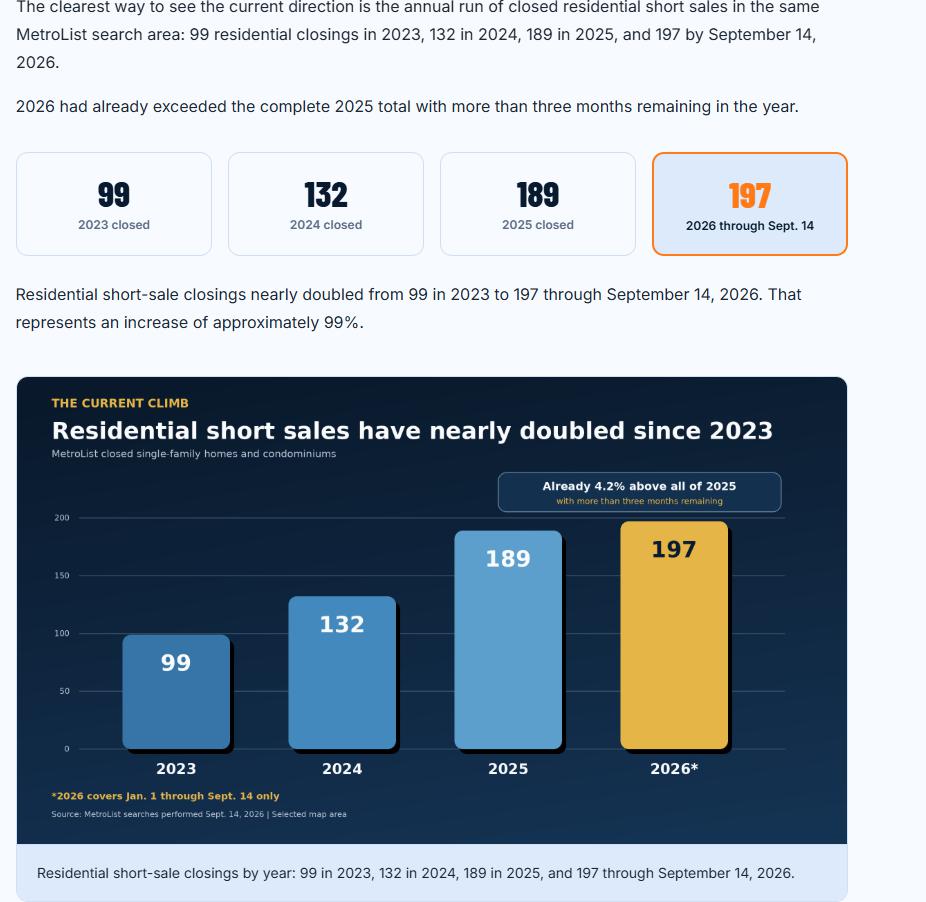
The clearest way to see the current direction is the annual run of closed residential short sales in the same MetroList coverage area (Sacramento, Placer, El Dorado, Yolo, and San Joaquin counties): 99 residential closings in 2023, 132 in 2024, 189 in 2025, and 197 by September 14, 2026.
2026 had already exceeded the complete 2025 total with more than three months remaining in the year.
Residential short-sale closings nearly doubled from 99 in 2023 to 197 through September 14, 2026. That represents an increase of approximately 99%.
| Reporting period | Single-family | Condominiums | Total residential |
|---|---|---|---|
| 2006 (Jan. 1 through Sept. 14) | 124 | 8 | 132 |
| 2007 full year | Not separately calculated | Not separately calculated | 1,168 |
| 2023 full year | 91 | 8 | 99 |
| 2024 full year | 119 | 13 | 132 |
| 2025 full year | 171 | 18 | 189 |
| 2026 through Sept. 14 | 176 | 21 | 197 |
Residential properties only: single-family residences and condominiums.
What Happened Between 2006 and 2007?
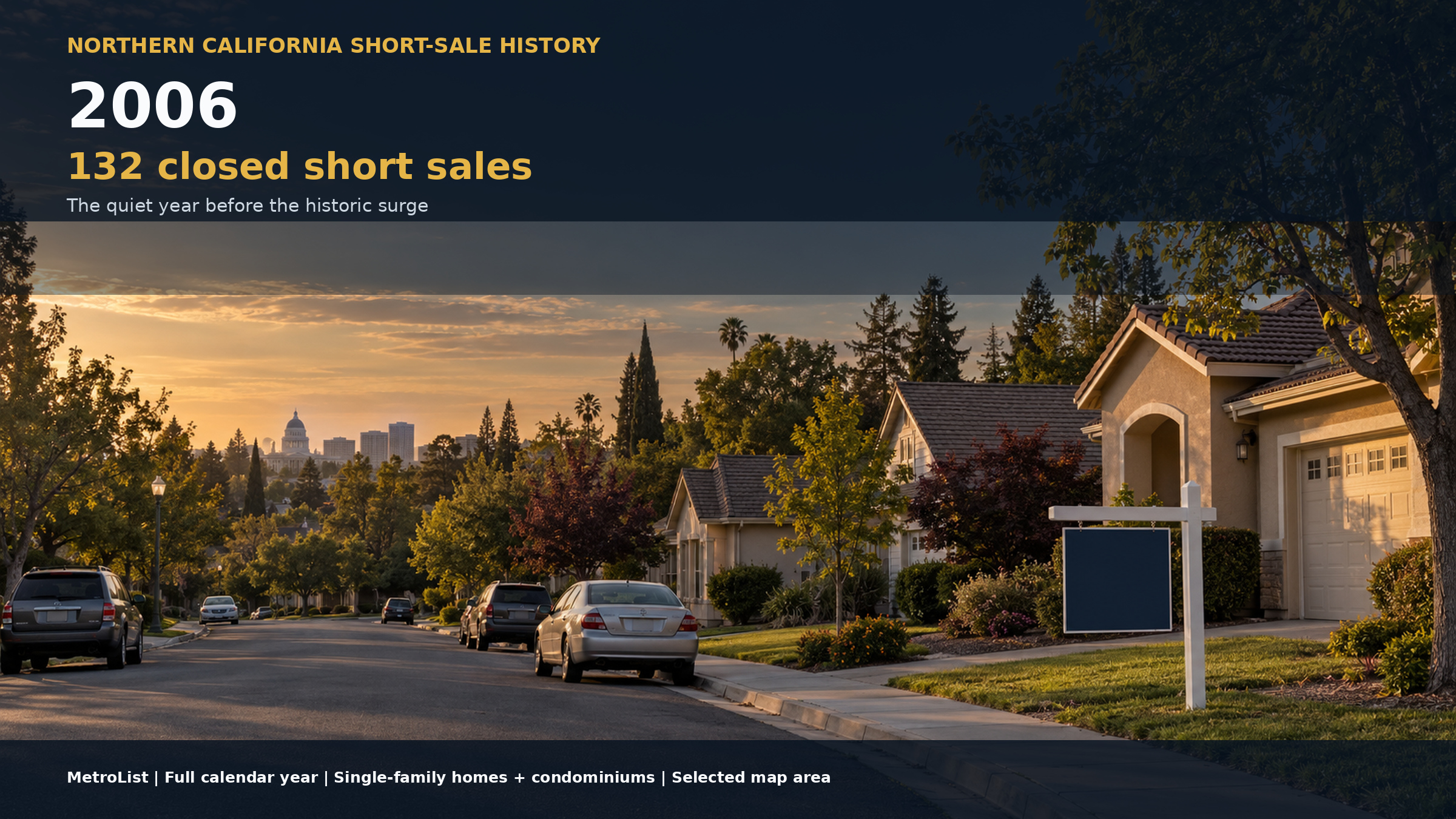
2006 was, by comparison, a quiet year: 132 closed residential short sales. Note that the 2006 figures cover January 1 through September 14 only, about nine months and fourteen days, not a full 365-day calendar year, while the 2023, 2024 and 2025 figures are complete calendar years. Then the numbers moved in a way that was anything but gradual.
- 1,036 numerical increase from 2006 to 2007
- 784.8% percentage increase from 132 to 1,168
- 8.85x 2007 volume relative to 2006 volume
- 1,168 closed residential short sales in 2007
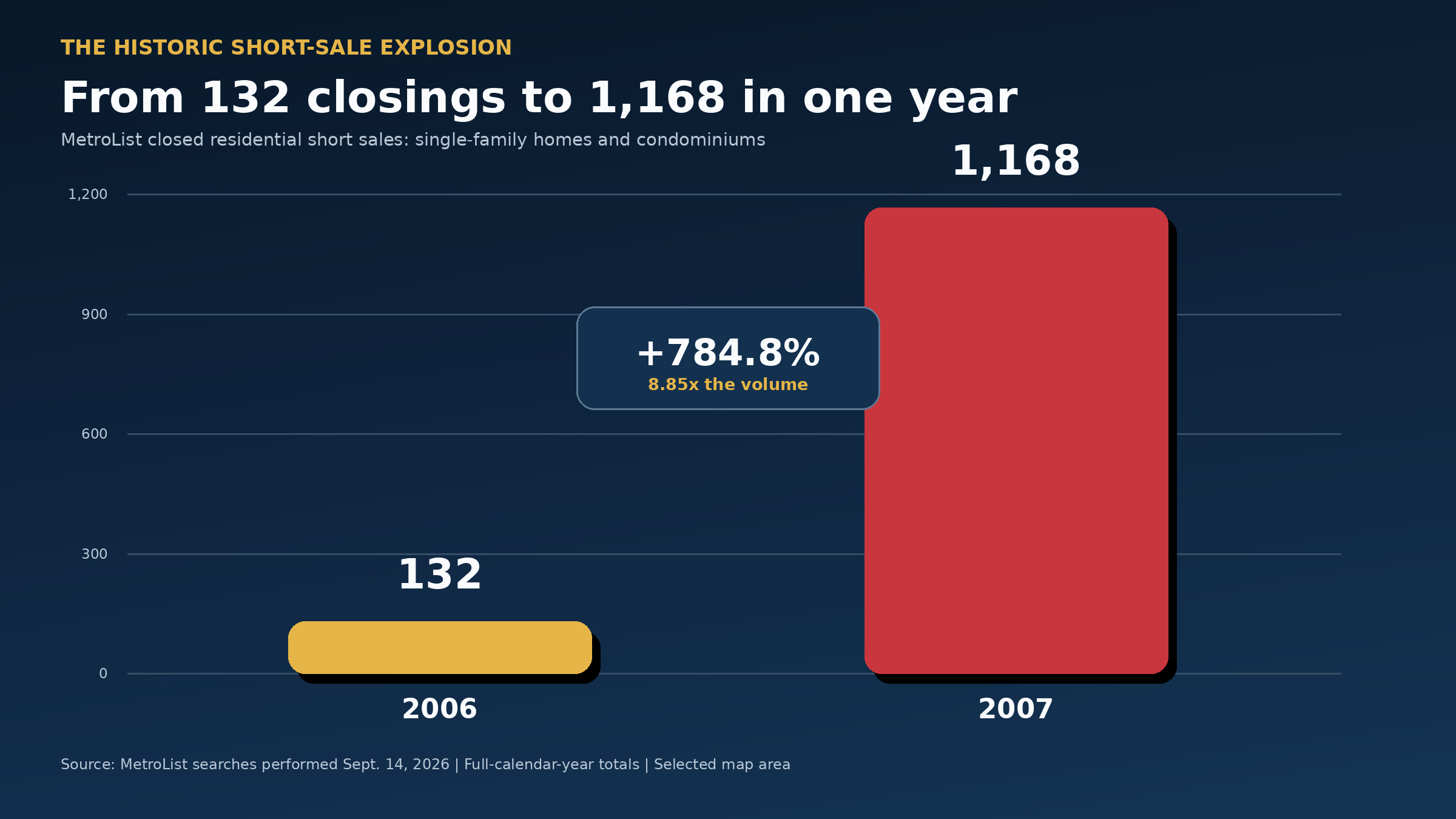

The change between 2006 and 2007 was not a normal market fluctuation. MetroList short-sale closings increased almost ninefold in a single year. That is what a genuine distressed-market eruption looks like.
This is where the history stops being an abstract chart for me. I was licensed in 2004 and completed my first short sale in 2007. I later handled more than 100 REO listings. I saw how quickly missed payments, declining values, adjustable-rate mortgages and lender backlogs changed the market in Northern California.

Are We Back to 2007?
No, not based on closed volume. The comparison is direct:
- 2026 through September 14: 197 closings.
- Full-year 2007: 1,168 closings.
- Current 2026 closings equal only 16.9% of the 2007 total.
- The 2007 total was approximately 5.9 times the current 2026 count.
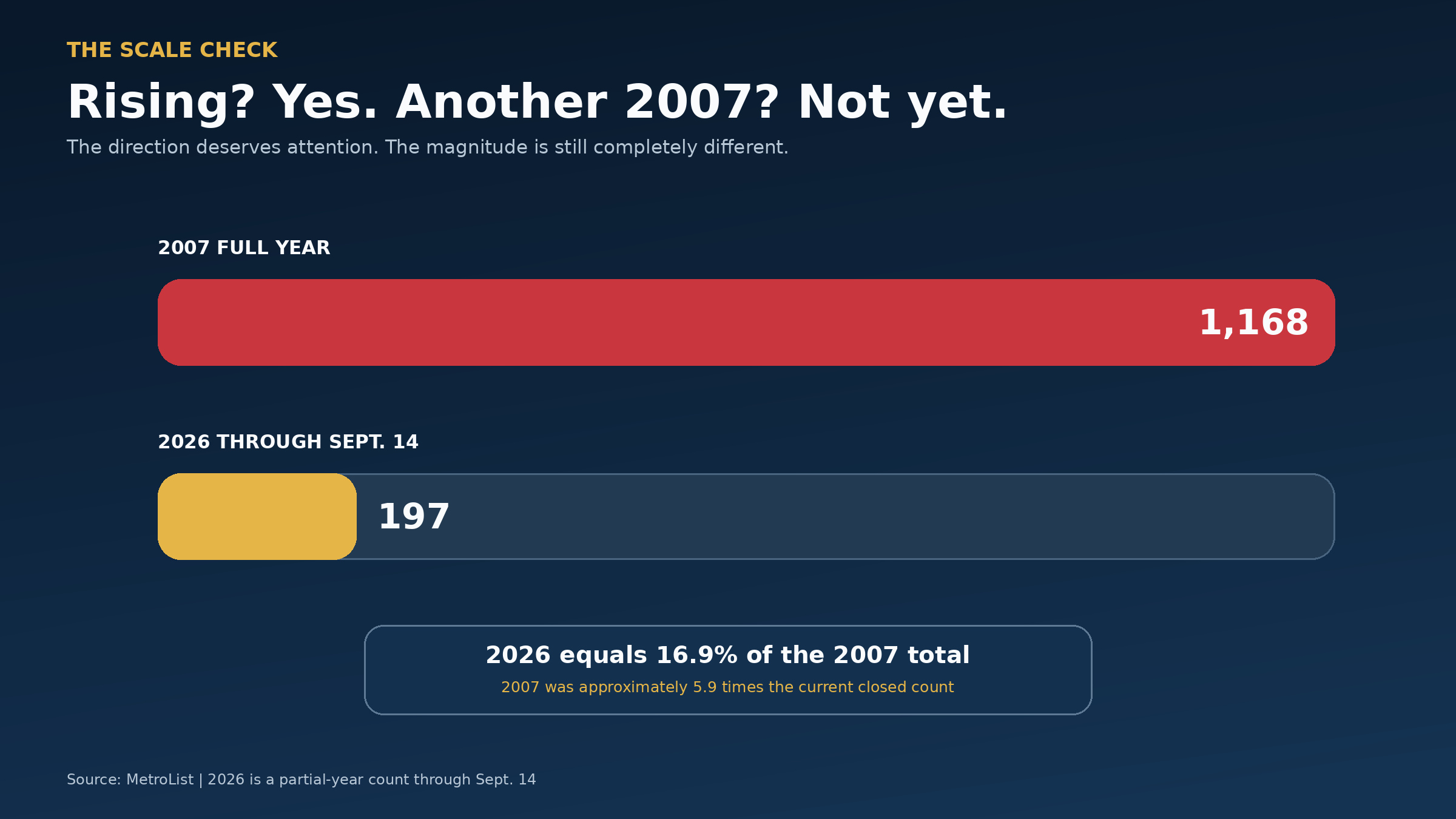
The direction deserves attention, but the scale is completely different. Short sales are increasing, yet calling this another 2007 would be premature and inaccurate. We are seeing warning lights, not the entire dashboard catching fire.
A straight-line pace would place 2026 near approximately 280 closings by year-end. Label this only as a mathematical pace, not a forecast. Even 280 would equal approximately 24% of the 2007 total.
The Pipeline Behind the Closed Sales
The closed sales are only part of the picture. The current status snapshot tells the rest of the story:
| Status as of Sept. 14, 2026 | Single-family | Condominiums | Combined |
|---|---|---|---|
| Active | 152 | 27 | 179 |
| Contingent or pending | 155 | 28 | 183 |
| Current pipeline | 307 | 55 | 362 |
In addition to the 197 residential short sales already closed, MetroList showed another 362 active, contingent or pending short sales.
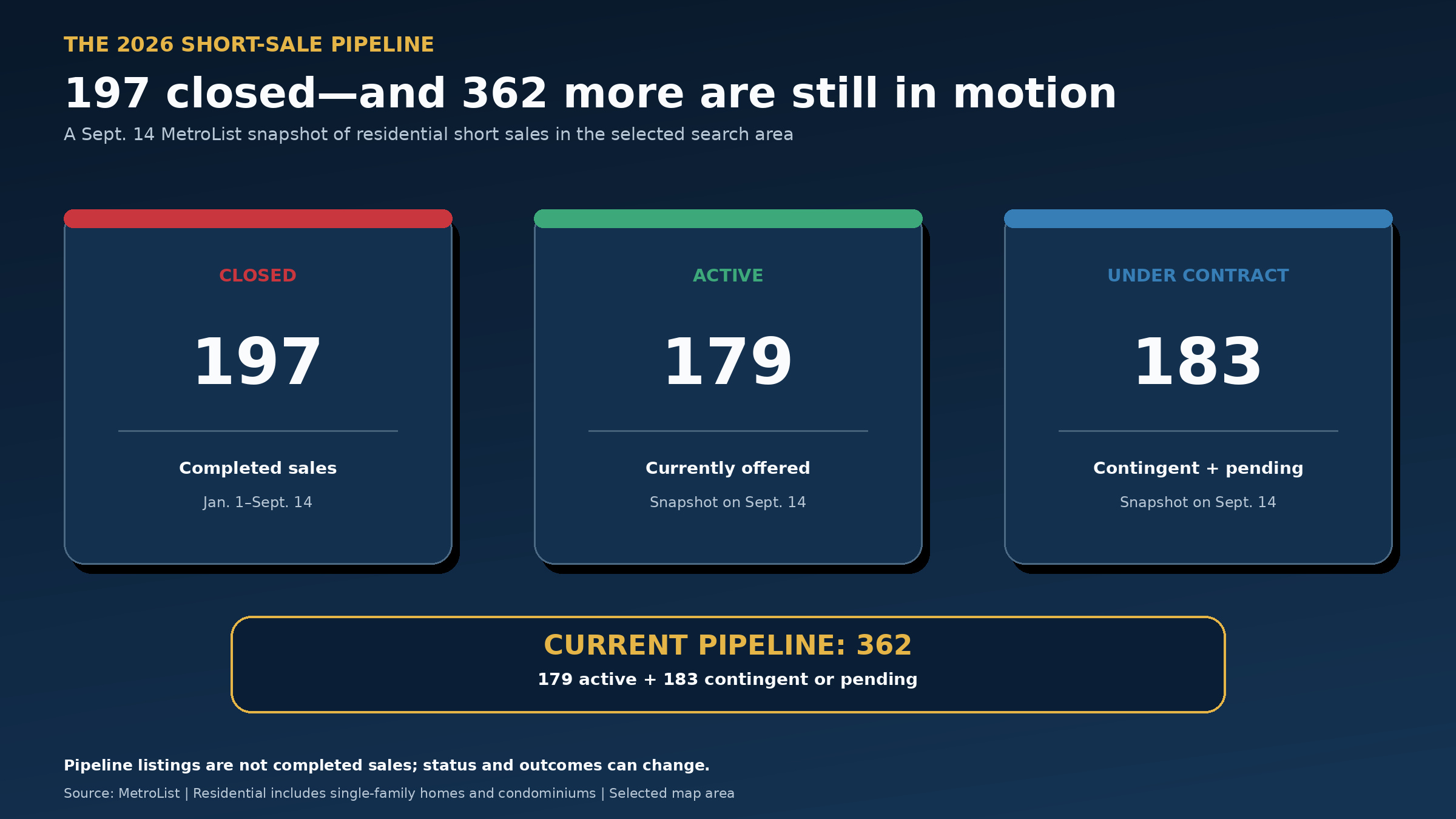
These are not completed transactions. Some may cancel, expire, return to active status or fail to receive lender approval. The pipeline nevertheless indicates that distressed-property activity is continuing rather than fading.
At the current pace, with the number of homes that are still active and pending, 2026 could easily hit 300 short-sale closings this year.
Short-Sale Prices Then and Now
| Period | Closed short sales | Average closing price | Median closing price |
|---|---|---|---|
| 2006 (Jan. 1 through Sept. 14) | 132 | $464,120 | $342,250 |
| 2007 full year | 1,168 | $389,641 | $340,000 |
| 2023 full year | 99 | $584,453 | $500,000 |
| 2024 full year | 132 | $568,460 | $494,500 |
| 2025 full year | 189 | $519,222 | $430,000 |
| 2026 through Sept. 14 | 197 | $567,843 | $487,000 |
What Is the Difference Between Average and Median?
The average closing price is calculated by adding together every closing price and dividing that total by the number of sales. The median closing price is the middle sale when every closing price is arranged from lowest to highest. Half of the properties sold above the median and half sold below it.
Although people often think "average" means the middle or typical price, a few unusually expensive or inexpensive properties can pull the average much higher or lower. The median is less affected by those outliers and often provides a clearer picture of what a typical property sold for.
In 2006, the average short-sale closing price was $464,120, while the median was only $342,250. The large difference was influenced by higher-priced transactions, including one sale above $12 million. That exceptional sale raised the average substantially, but it did not represent what most short-sale properties sold for.
The median helps homeowners understand the price range near the center of the market. The average helps show how the complete mix of lower-priced, typical and luxury properties affected the overall market. Looking at both prevents a handful of unusually expensive sales from creating a misleading impression of typical short-sale values.
Average Closing Price
All closing prices added together and divided by the number of sales. More affected by unusually high or low sales.
Median Closing Price
The middle closing price. Half of the sales were higher and half were lower. Usually a better indicator of the typical sale.
Why Today's Distressed Market Is Different
Rising short-sale counts do not automatically mean California is entering another foreclosure crisis, and here is why:
-
Many current owners purchased or refinanced at different points in the market.
-
A short sale depends on the property's current value, total mortgage debt, selling expenses and lender requirements.
-
A homeowner can face a legitimate hardship even when the broader market has not crashed.
-
Job loss, divorce, illness, death, business failure, relocation and unaffordable payment changes can create distress.
-
Higher property prices do not guarantee that every owner has enough equity to sell normally.
A market does not have to collapse for an individual homeowner to need a short sale.
Why Are Short Sales Doubling in 2026 If It's Not 2007?
If the broader market is not crashing, why are short-sale closings up roughly 99% from 2023? The answer is not one single cause. Several financial pressures are converging at the same time, and they hit specific homeowners far harder than the market as a whole, especially in Northern California's higher-priced counties.
-
Property insurance spikes. Homeowners insurance premiums in California have climbed sharply, and some policies are not being renewed at all. For a homeowner already stretched thin, an insurance bill that jumps by thousands of dollars a year can turn an affordable mortgage into an unaffordable one, even when the loan itself did not change.
-
Mature HELOCs. Many second mortgages and home equity lines of credit taken out during the last cycle are reaching the end of their interest-only or draw periods. When the balance begins to amortize, the payment can step up substantially, creating a hardship for owners who assumed the line would stay inexpensive indefinitely.
-
Variable rate resets. Adjustable-rate loans written when rates were at historic lows are resetting to current market rates. A reset can raise a monthly payment significantly and push an owner who had kept up with payments into arrears.
-
Slowing appreciation. Values are not falling the way they did in 2007, but the rapid appreciation of recent years has slowed, and some areas have leveled off or eased. An owner who bought or refinanced near the peak can find that sale proceeds no longer cover the payoff, which is the exact condition that defines a short sale.
Gary Lee's Firsthand Experience Through Two Markets
Gary Lee has been a full-time California REALTOR® since 2004 and has handled more than 100 REO listings. CDPE stands for Certified Distressed Property Expert. Gary got his CDPE certificate in 2009, but he did his very first short sale in 2007. His experience was earned inside the market, working with homeowners, lenders, servicers, asset managers, buyers and agents when distressed transactions were part of everyday real estate.
- 2004 California REALTOR® since 2004
- 2007 Completed his first short sale in 2007
- 2009 CDPE (Certified Distressed Property Expert) certification completed in 2009, certificate dated July 17, 2009
- 100+ REO listings handled
- DRE #01448722 Gary Lee, California license
- eXp Realty The Gary Lee Team at eXp Realty of Northern California, Inc.


Gary is not predicting the next 2007. He is documenting what MetroList is showing and applying nearly two decades of distressed-property experience to explain what the numbers actually mean.

Gary Can Help Throughout California
SacramentoShortSale.com is based in the Sacramento region, but Gary Lee's California real estate license is statewide. He can represent qualifying short-sale sellers throughout California, subject to the property, lender requirements and brokerage review.

If you already have a REALTOR® you trust, you do not necessarily have to choose between that relationship and experienced short-sale guidance. Your agent may contact Gary to discuss possible cooperation or short-sale coordination, subject to the existing agency agreement, seller authorization and broker approval.
Homeowner Warning Signs
A short sale deserves a closer look when one or more of these describe your situation:
-
You owe more than the property may sell for after expenses.
-
You have missed payments or expect to miss them soon.
-
You received a Notice of Default.
-
A trustee-sale date may be approaching.
-
A loan modification was denied or is unaffordable.
-
You have a first mortgage plus second liens or assistance loans.
-
Property taxes, HOA balances or PACE assessments complicate the payoff.
-
You need to relocate but cannot bring money to closing.
-
Your current agent has limited short-sale experience.
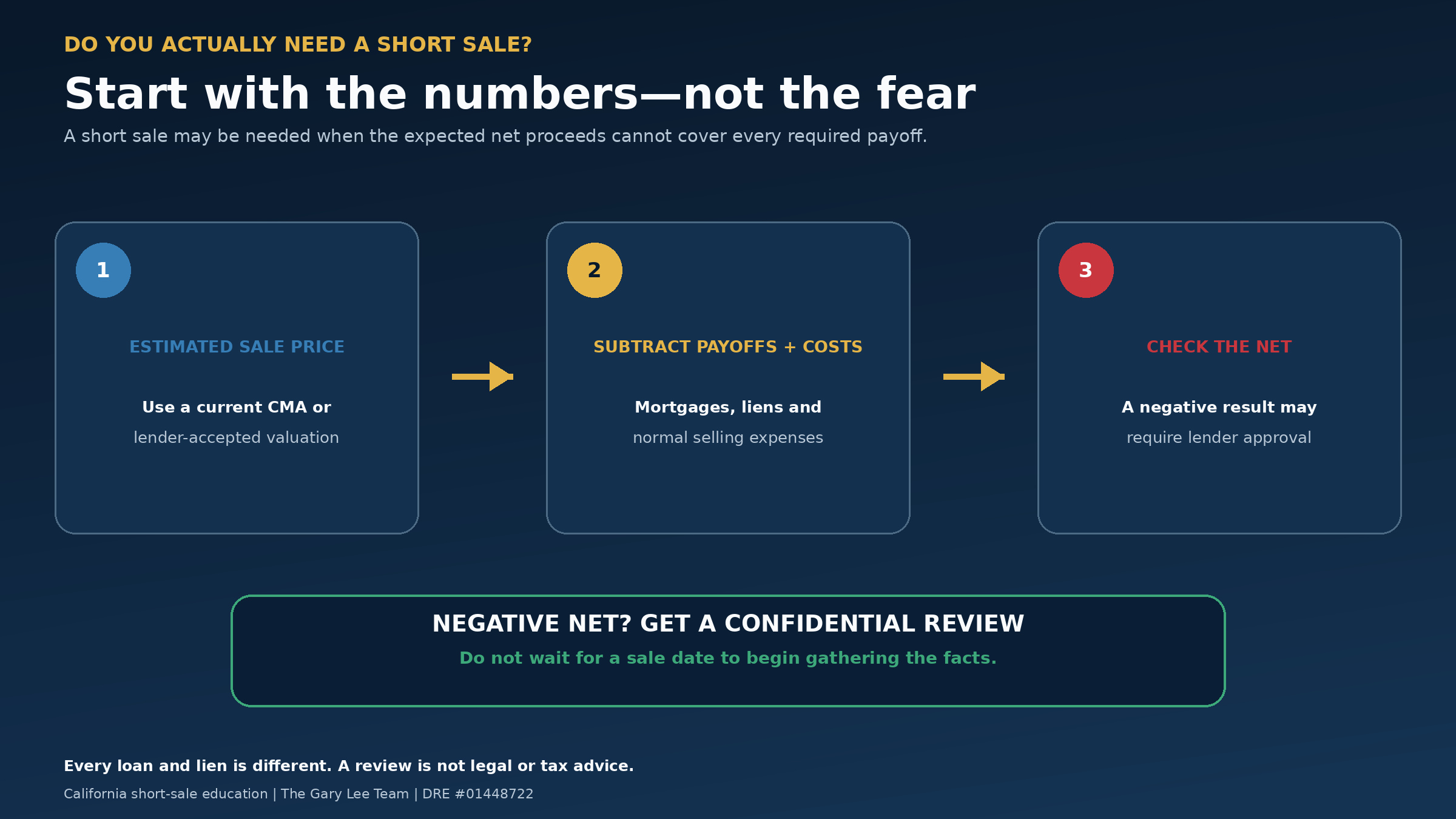
You do not need to wait until the foreclosure process is nearly over. The earlier the loan, title, value and timeline are reviewed, the more options may remain available.
Short Sale FAQs
Are short sales increasing in Northern California?
Yes. MetroList recorded 197 closed residential short sales between January 1 and September 14, 2026. That already surpassed the 189 recorded during all of 2025 and nearly doubled the 99 recorded in 2023. Northern California is still nowhere near the 1,168 that closed in 2007.
Are we heading back to the 2007 housing crisis?
Not based on closed volume. The 197 short-sale closings through September 14, 2026 equal only 16.9% of the 1,168 recorded in 2007. Short sales are rising, but the scale is completely different. This is closer to warning lights than another 2007.
How many MetroList short sales closed in 2007?
MetroList recorded 1,168 closed residential short sales during 2007 within the analyzed coverage area (Sacramento, Placer, El Dorado, Yolo, and San Joaquin counties via MetroList MLS), approximately 8.85 times the 132 recorded in 2006 (January 1 through September 14 only, about nine months and fourteen days, not a full 365-day calendar year).
How many have closed so far in 2026?
197 residential short sales closed between January 1 and September 14, 2026, already more than the 189 that closed during all of 2025, with more than three months remaining in the year.
What is the difference between a short sale and a foreclosure?
A short sale is a negotiated sale in which the lender agrees to accept less than the full amount owed and the homeowner transfers the property through a closing. Foreclosure is a legal process in which the lender takes ownership of the property through a trustee sale. They are different processes with different timelines and consequences.
Can Gary Lee represent a short-sale seller anywhere in California?
Gary Lee's California real estate license is statewide. He can represent qualifying short-sale sellers throughout California, subject to the property, lender requirements and brokerage review.
Can Gary help if the seller already has another REALTOR®?
Yes, in a way that respects the existing relationship. If you already have a REALTOR® you trust, your agent may contact Gary to discuss possible cooperation or short-sale coordination, subject to the existing agency agreement, seller authorization and broker approval.
Does a homeowner have to be behind on payments to request a short sale?
No. A homeowner does not have to be behind on payments to explore a short sale. What matters is the complete financial picture, including the property value, total mortgage debt, selling expenses and lender requirements.
How long does a California short sale usually take?
Actual timelines vary significantly from file to file and cannot be promised. Timing depends on the lender, investor, documentation, lien structure and buyer. The earlier the file is reviewed, the more options may remain available.
Will the lender approve every short-sale request?
No. Approval is not guaranteed. Every lender, investor, loan and lien situation is different, and approval depends on the specific circumstances of the property and the homeowner.
A Conversation Does Not Obligate You
If you own a California property and believe you may need a short sale, I would be honored to speak with you. A conversation does not obligate you to list your property, and it may help you understand whether a short sale is truly necessary. If you already have a REALTOR® in mind, your agent is also welcome to contact me to discuss how I may be able to assist with the short-sale process.

Gary Lee, REALTOR®
Founder, SacramentoShortSale.com and Short Sale Deal Maker
California DRE #01448722
The Gary Lee Team at eXp Realty of Northern California, Inc.
Brokerage DRE #02188495
Call or text for a confidential conversation.