Does a Short Sale Cost You Money? What Sacramento Sellers Should Expect
In many approved short sales, lender-approved commissions and customary seller closing expenses are paid from the transaction proceeds rather than out of the homeowner's pocket. Every charge is still subject to the purchase agreement, lender or investor approval and the final settlement statement. Sellers should never be promised that every possible expense will be approved.
By Gary Lee, REALTOR | Founder and Lead Short Sale Negotiator | California DRE #01448722
Gary Lee has worked with homeowners in mortgage default since 2007, been a licensed California REALTOR for more than 20 years, completed CDPE coursework in 2009, and founded SacramentoShortSale.com and ShortSaleDealMaker.com.
The Short Answer: Approved Costs Come Out of the Proceeds
Whether you bring money to closing depends on the approval the lender or investor actually gives, not on a general rule. The approval letter and the settlement statement decide what gets paid, and every charge can be reduced or rejected during review.
The question I hear most often is, "Am I going to have to write a check at closing?" The honest answer is that it depends. The sections below explain what "paid from the proceeds" means and which expenses sit inside or outside the settlement.
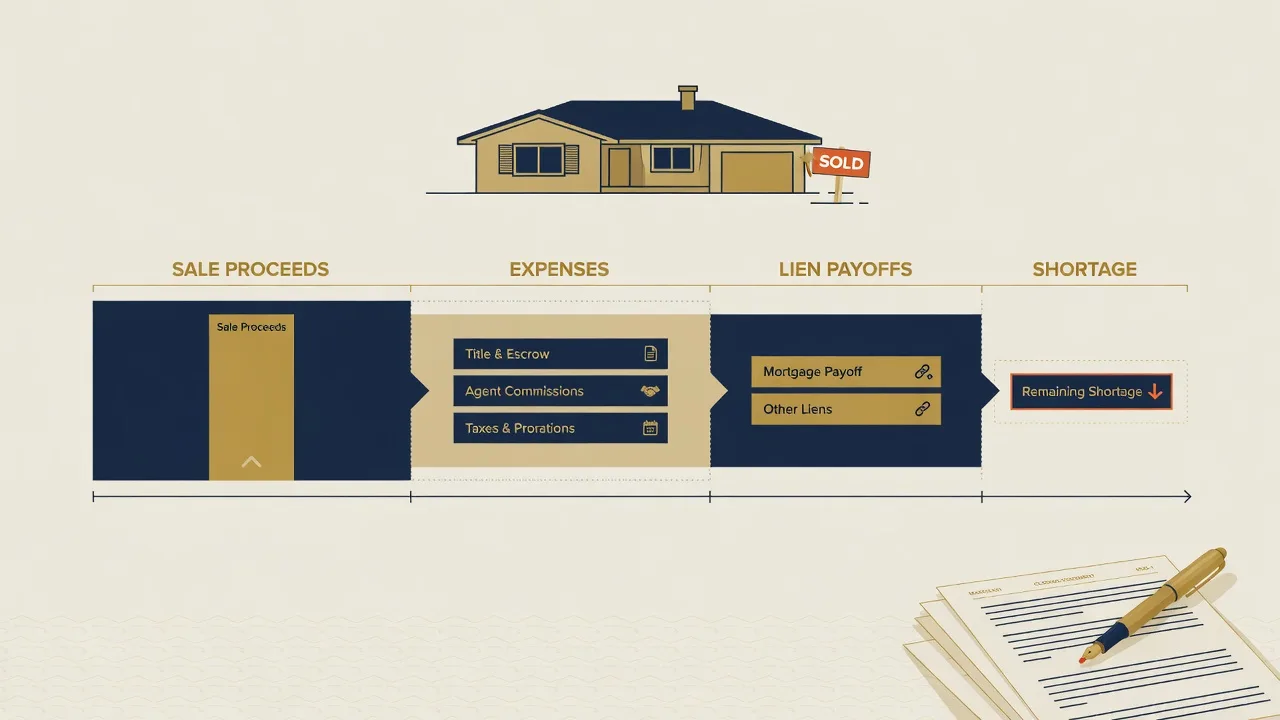
What "Paid From the Proceeds" Actually Means
In a completed short sale, the buyer's funds are deposited into escrow and disbursed according to the final settlement statement, escrow instructions, approved short-sale terms, payoff demands and title requirements. Approved commissions, closing expenses and lien payoffs must all be properly shown and authorized before closing, which is not the same as determining the legal priority of competing liens.
The catch: a charge is only paid when the lender or investor approves it and it appears on the final settlement statement.
| Expense | Common treatment | Approval required? | Possible seller exposure |
|---|---|---|---|
| Listing and buyer-broker compensation | Paid from approved proceeds when approved | Yes | Approved amount may be lower than the listing agreement |
| Escrow and title charges | Paid from proceeds within customary ranges | Yes | Charges above the customary range may be challenged |
| Documentary transfer tax | Authorized by statute, allocated by the purchase agreement | Yes, as a closing item | Usually falls to the seller under the agreement |
| Property-tax proration | Split between buyer and seller at closing | Yes | Prorated share deducted from proceeds |
| Delinquent property taxes | Must be resolved before title can be delivered | Yes | Reduce net proceeds or need separate resolution |
| HOA document fees | Paid to the association for the document package | Yes | Authorized document fee may still be due |
| Delinquent HOA assessments | Generally must be satisfied or otherwise resolved | Yes | May reduce proceeds or need separate resolution |
| Repairs or buyer credits | May or may not be approved | Yes | Could come out of proceeds or need negotiation |
| Utilities and property maintenance | Commonly outside the approved settlement | No | Usually out-of-pocket |
| Moving expenses | Commonly outside the approved settlement | No | Usually out-of-pocket |
| Second-lien payoff or contribution | Negotiated with the junior lienholder, limited by senior approval | Yes | Possible contribution demand |
| Judgments and tax liens | Must be resolved to clear title | Yes | May reduce proceeds or need separate resolution |
| Solar obligation | Handled per lease, PPA or loan terms | Depends on the program | Transfer, assumption or payoff terms vary |
| PACE assessment | Treated as a property-tax assessment in California | Depends on the program | Program-specific resolution required |
| Short-sale negotiation or coordination fee | Governed by the written agreement | Per the written agreement | Disclosed in writing, not collected upfront |
Treatments vary by file, purchase agreement, loan program and investor. The table explains how an expense is typically handled; it does not promise that every file has the same cost.
Real-Estate Commissions and Why They Remain Negotiable
Commissions are not set by law and are negotiated between the seller and the listing broker, with the buyer broker's compensation part of the same conversation. In a short sale the lender or investor reviews the commission during approval and can negotiate it down; the number that matters is the one in the approval letter and on the settlement statement.
Escrow, Title and Transfer-Related Charges
Escrow fees, title insurance, recording fees and the documentary transfer tax are customary seller costs. The transfer tax is authorized under California Revenue and Taxation Code Section 11911 and is the seller's expense unless the purchase agreement says otherwise.
The purchase agreement splits the rest: buyer's loan costs, inspections and, in many areas, buyer's title insurance are buyer expenses; the transfer tax, the owner's title policy and a share of escrow are typically seller expenses. The short-sale closing checklist in the Short Sale Knowledge Center shows how approved charges flow at closing.
Property Taxes and Prorations
Property taxes are prorated at closing, with escrow dividing the current tax year so each side pays its share. Delinquent taxes are different: unpaid taxes become a lien that must be addressed to deliver clear title, and a delinquency does not disappear because the sale is a short sale.
Possible income tax arising from canceled mortgage debt is not a closing cost shown in the same way as escrow, title or transfer charges. A lender may later issue Form 1099-C, and federal and state tax treatment depends on the seller's circumstances. Review the separate Short Sale Taxes in 2026 guide and consult a qualified tax professional.
HOA Dues, Transfer Fees, Document Fees and Delinquent Assessments
If the property is in an association, regular HOA dues are prorated at closing like taxes, and the association may charge a transfer fee plus a fee for the document package and statement of accounts. Civil Code Section 4530 caps that document fee at a reasonable amount based on actual cost and requires separate itemization.
California Civil Code §4530 generally requires an association to provide the requested sale documents within 10 days after a written request. Delivery cannot be withheld because assessments are delinquent, although the association may require payment of the authorized document-preparation fee. Delinquent assessments and any recorded HOA lien remain separate title and payoff issues that generally must be satisfied, released or otherwise resolved before the buyer receives the title coverage required for closing.
Repairs, Inspections, Utilities, Moving and Property Maintenance
Moving expenses, utilities, property maintenance and pre-listing work are commonly outside the lender-approved settlement. Buyer-requested repairs, inspection-related charges or closing credits may or may not be approved, depending on the purchase agreement, loan program, investor requirements and effect on the lender's net proceeds. Plan for utilities and maintenance as out-of-pocket realities.
Judgments, Tax Liens and Other Title Problems
Recorded judgments, IRS or state tax liens, support liens and mechanic's liens can all attach to the property. Each must be resolved or the sale cannot deliver clear title; the lender does not automatically authorize paying every non-approved lien from the proceeds, so the lien holder may need to accept less. A title search reveals what is recorded; the HOA liens and title problems guide and the short-sale process guide cover how title clouds get cleared.
Second-Lien Contribution Demands
When a second mortgage or HELOC holder will not be fully paid from the sale proceeds, it may demand a contribution toward its loss before releasing its lien, sometimes aimed at the seller. An unpaid second lien blocks clear title, so the junior lienholder has to be addressed either way.
These demands are negotiated, and any payment still has to fit within what the senior lender approves. A seller can decline a contribution demand, but doing so can put the whole transaction at risk. The junior liens and HELOCs guide explains how these holders behave and what short-payoff arrangements look like. Lien release, short payoff, personal liability and tax reporting are related but different questions, covered in the California short-sale deficiency guide .
Solar, PACE and Other Property-Related Obligations
Solar leases and power purchase agreements do not always transfer cleanly to a new buyer; a PACE assessment attaches to the property and is repaid through property taxes; and down-payment assistance loans are often recorded as second mortgages with their own payoff and approval requirements.
None of these disappear because the property is in a short sale. In California, a residential PACE obligation is generally collected as a property-tax assessment and may have priority characteristics different from an ordinary mortgage lien, so a sale may require payoff, assumption, transfer or another program-specific resolution. The applicable PACE administrator, tax records, title report, buyer financing and lender requirements must be reviewed before stating how the assessment will be handled; PACE structures vary outside California, so the same treatment should not be assumed elsewhere.
Negotiation or Transaction-Coordination Fees
Short Sale Deal Maker's policy is not to collect a short-sale negotiation or transaction-coordination fee from a homeowner upfront. Any proposed fee, who pays it, when it is due and whether lender approval is required must be disclosed in the written agreement.
That is the company's policy, not a universal legal rule. Fee structures vary among providers and across states. Anyone who asks a homeowner to pay a negotiation or coordination fee upfront deserves careful scrutiny; review the written agreement before signing.
Reviewing the Approval Letter and Final Settlement Statement
Two documents tell the real story of what a short sale costs: the approval letter states the approved price, payoff amounts, closing deadline and any conditions, while the settlement statement shows where every dollar actually goes. Read them together before you sign: a charge not on the final settlement statement should not be assumed to be paid through escrow, and a condition not in the approval letter or its incorporated documents should not be assumed approved.
The short-sale approval letter guide and the lender escalation guide explain how approvals get negotiated, the closing checklist lists what to look for, and the California short-sale representation page shows how The Gary Lee Team handles these questions.
When a Seller Might Need to Approve an Addendum Involving an Out-of-Pocket Expense
In California, Code of Civil Procedure Section 580e(b) provides that, for a transaction governed by Section 580e, the holder may not require the borrower to pay additional compensation beyond the sale proceeds in exchange for written consent to the short sale. That is why a normal California short-sale lender generally cannot lawfully condition its consent on a borrower contribution, a promissory note, new repayment terms, or any other additional compensation as the price of granting consent.
This is a California statutory rule and does not necessarily apply outside California, where lender demands are governed by different law. Even so, each lender's demands should still be reviewed carefully, including by a California attorney when appropriate, before anything is signed. If a seller is nonetheless presented with an addendum involving an out-of-pocket item, never sign under pressure: get the exact amount, due date and consequence of not paying in writing, and read the addendum carefully, as it is a legal change to the contract.
Warning Signs Involving Advance-Fee or Foreclosure-Rescue Scams
Watch for: a large upfront fee before any result; a promise that a short sale is guaranteed or that foreclosure will definitely be stopped; misrepresentation of a license, professional role, government affiliation or authority; high-pressure tactics and short deadlines; requests for payment in cash, gift cards or wire transfers, or directions to send money anywhere other than to the lender; and offers to "take over" your home or rent it back while keeping title in their name, a classic equity-skimming scheme, or to sign documents without reading them.
Depending on the service, legitimate assistance may come from a properly licensed real-estate professional, a California attorney, the homeowner's lender or servicer, a HUD-approved housing counselor or another authorized organization. Verify the person's role and credentials through the appropriate licensing agency or government directory; the California Attorney General's foreclosure-rescue scam guidance explains what to watch for and how to report it.
California and federal rules place significant restrictions on advance fees for many mortgage-relief and foreclosure-consulting services, so a request for money before services are performed deserves careful scrutiny; verify the provider's role, license, written agreement and legal authority before paying. The short-sale fraud guide explains the patterns and why Short Sale Deal Maker will not participate in them.
Sacramento Short-Sale Seller Cost FAQs
Does a Sacramento short-sale seller need to bring money to closing?
Not necessarily. In most completed short sales, approved commissions and customary seller closing costs are paid through the transaction proceeds, but every charge is subject to the purchase agreement, lender or investor approval, and the final settlement statement. A seller may or may not be asked to contribute, and that decision belongs to the lender or investor, not the agent.
Who pays the real-estate commission in a short sale?
The approved commission is normally paid from the sale proceeds at closing, if the lender or investor approves it as part of the short-sale approval. Commissions are not fixed by law and remain negotiable. In a short sale the lender reviews the commission and can negotiate it down, so no commission should be assumed until it appears on the approved settlement statement.
Who pays escrow, title and transfer costs in a short sale?
Customary seller closing expenses such as escrow fees, title insurance, recording fees, and the documentary transfer tax are generally paid from the transaction proceeds when the lender approves them. The transfer tax is authorized under California Revenue and Taxation Code Section 11911, and lenders typically expect these charges to stay within customary ranges for the area.
Can the lender reduce or reject a charge in a short sale?
Yes. The lender or investor reviews the proposed settlement statement before approval and can reduce or reject any charge, including the commission and other seller expenses. Every charge that actually gets paid must appear on the final settlement statement the lender approves.
Can a seller be asked to contribute money as a condition of short-sale approval?
Possibly. A lender or investor sometimes conditions approval on a seller contribution or another out-of-pocket item, usually as an addendum the seller is asked to sign. The seller can accept, counter, or decline. It should be in writing with the exact amount and timing, and it is the lender or investor that decides whether to ask, not the agent.
What is a second-lien contribution demand in a short sale?
When a second mortgage or HELOC holder will not be fully paid from the sale proceeds, it may demand a contribution toward its loss before it releases its lien. A junior lienholder has to be addressed or the sale cannot deliver clear title. These demands are negotiated, and any payment to the junior lienholder still has to fit within what the senior lender approves.
Are advance-fee or foreclosure-rescue services legitimate?
Proceed with caution. California and federal rules place significant restrictions on advance fees for many mortgage-relief and foreclosure-consulting services. Upfront fees before any result, promises of a guaranteed approval, high-pressure tactics, and foreclosure-rescue offers to save your home for a fee are warning signs. Verify any license with the California Department of Real Estate and get every term in writing. Short Sale Deal Maker does not collect a homeowner negotiation or transaction-coordination fee upfront.
Last reviewed and updated: September 2026