What Is Short Sale Fraud? Why We Will Not Participate in It
A short sale can solve a serious financial problem. Fraud can create a much bigger one. This article explains what short-sale fraud is, what an arm's-length transaction actually means, the warning signs professionals and homeowners should recognize, and the federal cases behind the rules. It also states plainly where Short Sale Deal Maker and Sacramento Short Sale stand: on the honest side of every transaction.
Last Verified: September 4, 2026 Educational resource Reviewed by The Gary Lee Team before publication
A short sale can solve a serious financial problem. Fraud can create a much bigger one. When
a mortgage lender approves a short sale, it is being asked to accept less than the full
amount owed. That decision is based on information submitted by the homeowner, real estate
professionals, buyer, closing professionals, and other parties involved in the transaction.
That information needs to be truthful. Short Sale Deal Maker and Sacramento Short Sale will
not knowingly participate in any transaction involving fabricated documents, fake buyers,
straw purchasers, false proof of funds, hidden agreements, undisclosed relationships, false
hardship information, or any other attempt to mislead a lender or manipulate the short-sale
approval process. There is no short sale worth committing fraud over. If a transaction
cannot be completed honestly, we do not want the transaction.
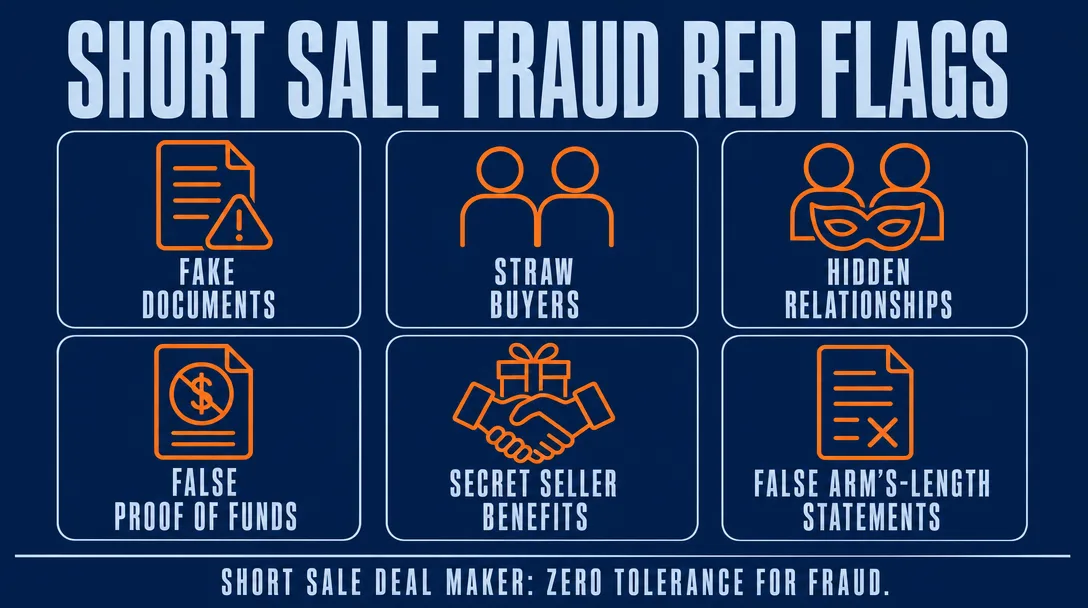
Careful document review is the first line of defense against short-sale fraud.
What Is Short Sale Fraud?
Short-sale fraud generally involves material misrepresentation, concealment, fabricated
information, undisclosed relationships, or deceptive conduct intended to influence a lender
or other approval party into approving a short sale, or approving it on terms it otherwise
would not accept. The deception can come from a homeowner, a buyer, a real estate agent, an
investor, or anyone else with a hand in the file.
Fraud is not an edge case that lenders made up to make life difficult. Federal agencies
actively track mortgage fraud risks, including false property information and the
misrepresentation of hardship or related information to influence a short-sale decision. The
Federal Housing Finance Agency's
Fraud Prevention program
exists precisely because fraudulent activity around mortgage transactions, short sales
included, is a recognized and persistent problem. Since Fannie Mae and Freddie Mac buy most
conforming mortgages, what they require shapes what servicers require, and what servicers
require shapes what a short-sale file must prove.
Our Policy Is Simple: No Short Sale Is Worth Committing Fraud
There is no commission, negotiation fee, listing, or transaction large enough to justify
fraud. A legitimate short sale should be presented honestly. The property value should be
presented honestly. The buyer should be real. The offer should be real. The hardship
information should be truthful. Material relationships and agreements should be disclosed
when required. If a proposed short-sale strategy depends on hiding material information from
the lender or creating documents that do not reflect reality, we will not participate. If
that is the kind of transaction you are looking for, please do not contact us.
What Is an Arm's-Length Transaction?
Arm's-length dealing is a common expectation in many real estate and mortgage transactions,
and it is especially important in short sales where a lender is being asked to approve a
discounted payoff. Freddie Mac defines an arm's-length short-sale transaction as one between
parties
who are unrelated and unaffiliated by family, marriage, or commercial enterprise apart from
the purchase and sale itself. Freddie Mac requires the parties to attest to that
relationship in a short-sale affidavit, and it says evidence of bad faith, collusion, or
fraud can require the servicer to withdraw agreement to the short sale and notify Freddie
Mac. See
Freddie Mac Single-Family Seller/Servicer Guide, Section 9208.2
.
An arm's-length transaction means the buyer and seller are genuinely acting independently
and are not secretly working together to manipulate the short sale.
The lender is agreeing to accept less than the full amount owed based on the information
presented. If relationships, agreements, payments, resale plans, or other material facts are
hidden, the lender may be making its decision based on false information.
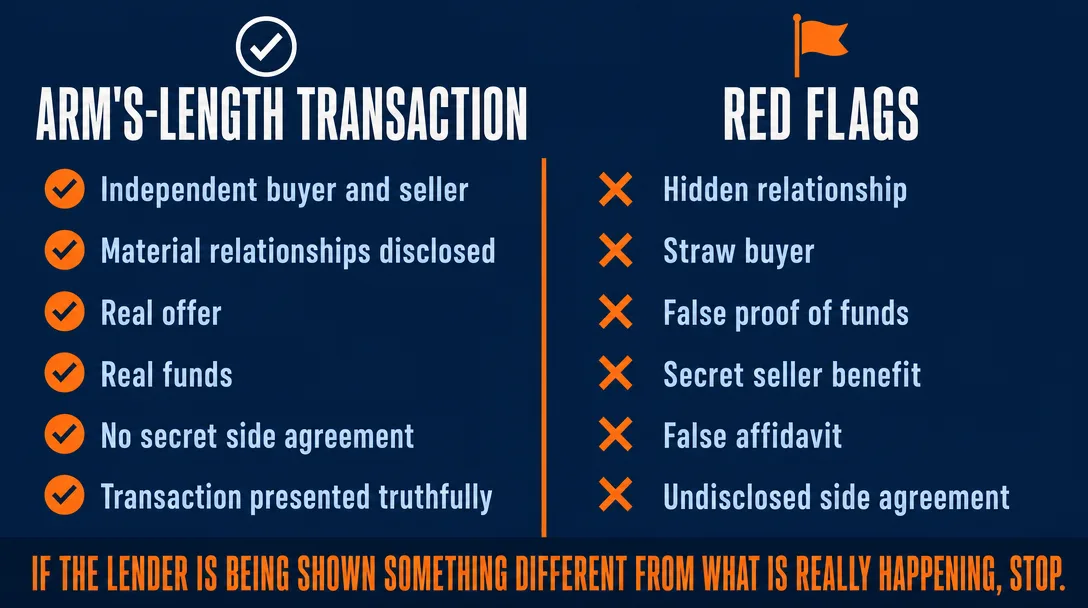
An arm's-length transaction presented truthfully, versus the red flags that should stop a deal.
Related Parties Are Not Automatically Fraud
A family member is not automatically disqualified from buying a short-sale property, and a
relationship between buyer and seller does not by itself make a transaction fraudulent.
What matters is what is disclosed and what the applicable rules require.
The relationship must be truthfully disclosed, and the transaction must comply with the
specific lender, investor, insurer, agency, and program requirements that apply.
Serious problems start when an applicable program requires arm's-length status and the
parties falsely claim they are unrelated. A knowingly false arm's-length representation can
constitute fraud or other actionable misconduct depending on the facts and applicable law.
Why Lenders Require Truthful Disclosure
A lender considering a short sale is being asked to accept less than the full debt. Before
it does, it needs confidence that the property was genuinely marketed, that the offer
reflects legitimate market demand, that there is no hidden higher price, and that the
parties are not colluding. It needs to know the seller is not secretly retaining an
undisclosed benefit, that the buyer is not a straw party, and that material information is
not being concealed.
Arm's-length certifications are not paperwork for paperwork's sake. They are the lender's
assurance that the transaction it is approving is the transaction that is actually
happening. Every hidden relationship, altered document, or fabricated figure degrades that
assurance, and if it later comes to light, the approval can be withdrawn, the file
investigated, and the participants exposed to serious consequences.
Common Red Flags of Short-Sale Fraud
These are the high-level patterns that cross the line. This is not how-to guidance. It is
the opposite of it: a checklist of what a compliant transaction should never contain.
Fake or altered purchase contracts.
False proof-of-funds letters.
Fabricated hardship information.
False income or financial information.
Straw buyers.
Undisclosed relationships between buyer and seller.
Secret agreements allowing the seller to regain control of the property.
Hidden payments or benefits to the seller.
Undisclosed resale arrangements.
Misrepresenting property value or condition.
Concealing a higher bona fide offer.
Providing false information about who the real buyer is.
Signing an arm's-length affidavit that is not true.
Using shell companies to conceal parties to the transaction.
Altering documents submitted to lenders or servicers.
Short Sale Deal Maker maintains a zero-tolerance policy for fraud.
“But Everybody Does It” Is Not a Defense
Fraud does not become legitimate because another agent suggested it, because a negotiator
said everyone does it, because an investor taught it at a seminar, or because someone has
done it before. It does not become legitimate because the seller agreed or the buyer agreed,
and it does not become legitimate because the lender probably will not find out.
Every one of those justifications describes the same act: submitting information that
misleads the party whose approval the transaction depends on. The lender's willingness to
accept a short payoff is only as valid as the information behind it. A transaction built on
false information is a fraud transaction regardless of how many people were part of the
pattern, how common the pattern is said to be, or how confident the participants are that
nobody will check.
It Is Not Only Fraud If Someone Loses Money
A common misconception is that conduct only becomes fraud when a specific victim loses a
specific amount of money. The law does not work that way. As a general principle, false
statements, forged documents, deceptive representations, and schemes to influence financial
institutions can create criminal exposure even apart from a simple who-lost-money analysis.
Submitting a false statement to a financial institution, presenting a forged document, or
participating in a scheme to deceive can be criminal conduct on its own, whether or not the
scheme ultimately profited.
This is not a criminal-law treatise, and the specifics vary by statute, jurisdiction, and
facts. The point for anyone working a short-sale file is simpler: do not assume that
conduct is safe because no one appears to have lost money yet.
Why Real Estate Professionals Have Even More to Lose
An unrepresented homeowner caught up in a bad scheme is in a bad position. A licensed real
estate professional who participates is in a worse one, because the professional's license,
reputation, and career are all on the line on top of everything else. Fraud-related conduct
can lead to criminal prosecution, prison, restitution, fines or civil penalties, civil
lawsuits, brokerage consequences, license suspension or revocation, federal agency
investigations, and loss of future professional opportunities.
Fraud-related conduct can put a real estate professional's license, livelihood, finances,
and freedom at risk.
No licensing authority automatically strips a license in every case, and every case is
decided on its own facts. But licensing authorities generally have the authority to suspend
or revoke a real estate license after certain fraud-related convictions. The
Texas Real Estate Commission
, for example, is one state commission that sets out the grounds and process for such
actions in its statutes and rules. Other states have similar authority. A conviction for
fraud-related conduct is the kind of event that can end a career, which is one more reason
the professional's answer to a bad idea has to be no, early and without ambiguity.
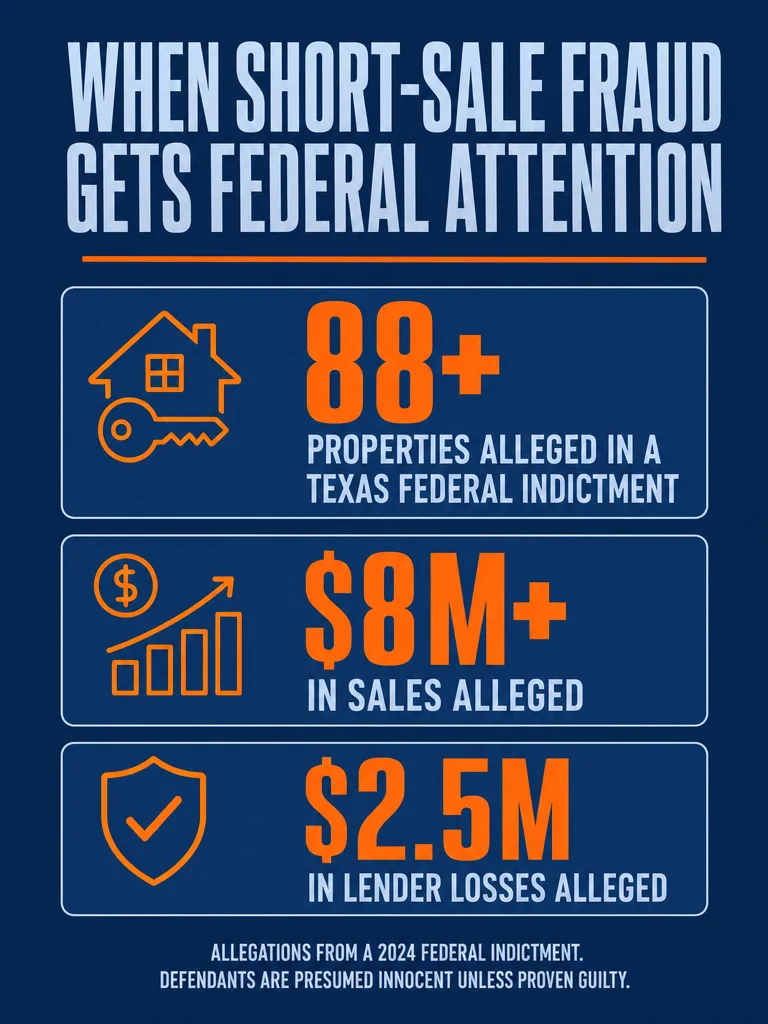
Alleged figures from a federal indictment. Defendants are presumed innocent unless proven guilty.
Federal Case | “Short Sale Queen” - Texas
A Real-World Warning: The Federal “Short Sale Queen” Case
The consequences of short-sale fraud are not hypothetical. In November 2024, a federal
grand jury indicted Nicole Espinosa, who called herself the “Short Sale Queen,”
along with Stephanie Smith and Selena Baltazar-Hill, in the Eastern District of Texas.
According to the Department of Justice, prosecutors alleged that the defendants
submitted fraudulent documents to financial institutions to delay or halt foreclosures,
including falsified purchase agreements and altered proof-of-funds letters. The conduct
allegedly involved at least 88 properties, more than $8 million in sales, roughly
$390,000 in commissions and processing fees, and approximately $2.5 million in losses
to financial institutions. Each defendant faced up to 30 years in federal prison if
convicted. Read the
Department of Justice press release
for the full account of the allegations.
The charges are allegations. An indictment is not a conviction, and the defendants are
presumed innocent unless proven guilty beyond a reasonable doubt.
The case is a warning regardless of its outcome, because it shows scale. A scheme built
out of falsified purchase agreements and altered proof-of-funds letters, spread across
dozens of properties, is exactly the pattern that attracts federal attention. Nobody
involved in that pattern set out to be a headline; they set out to make transactions
work by hiding the truth.
California Case | Straw-buyer scheme - guilty plea
California Case Study: A Guilty Plea in a Straw-Buyer Scheme
California has its own examples. In 2014, California real estate agent Minerva Sanchez
pleaded guilty to conspiracy to commit bank fraud in a fraudulent short-sale scheme.
According to the Department of Justice, the scheme involved a straw buyer, false
hardship representations, a hidden agreement for the seller to regain ownership, and
false statements that the transaction was arm's length, causing financial institutions
more than $316,000 in losses. See the
Department of Justice press release
.
Notice what the scheme combined: a straw buyer, fabricated hardship, a hidden agreement
to give the property back to the seller, and a false arm's-length claim. Each element
on its own looks like a workaround. Together they are the textbook of what this article
describes: a short sale engineered to look like one thing while being another.
Northern California Case | Modesto to Sacramento - federal prison sentences
California Case Study: Modesto to Sacramento
In April 2025, two defendants were sentenced to federal prison after a California
short-sale fraud scheme involving approximately 15 homes from Modesto to Sacramento. The
Department of Justice reported more than $3 million in lender losses, with straw buyers,
fabricated documents, shell companies, and false arm's-length representations involved.
Learn more from the
Department of Justice press release
.
This isn't theoretical. It has happened right here in Northern California.
Modesto to Sacramento is the team's own market. These are the towns our clients live
in, and the transactions our profession shares. When federal prosecutors describe shell
companies and fabricated documents in our own region, it is not a story about somewhere
else. It is a story about what a short sale becomes when the people involved decide that
hiding the truth is easier than doing the work.
What Legitimate Short-Sale Negotiation Looks Like
Legitimate short-sale negotiation is work, and it is work that can be done well. It starts
with an honest presentation of the property and its value, supported by real market
evidence. It uses real buyers making real offers. The hardship documentation is truthful and
complete. Material relationships and agreements are disclosed when required, and the
transaction complies with the lender, investor, insurer, agency, and program requirements
that apply.
None of that is glamorous, and none of it can be shortcut. The
short-sale process
has a documented order: gather the file, package the hardship, prepare the valuation,
negotiate the offer, and carry the transaction to approval. Read
how Short Sale Deal Maker works
to see how a compliant file is actually moved.
The Gary Lee Rule
That one question resolves most ethical dilemmas in this business. If a proposed step only
works until someone with authority asks a direct question, it is not a strategy, it is a
liability. Every file we touch should be one we could present, without redaction, to anyone
whose job it is to police the transaction.
How Short Sale Deal Maker Handles Legitimate Transactions
Short Sale Deal Maker provides short-sale negotiation strategy, foreclosure-process
education, transaction support, documentation guidance, and professional standards. That is
the whole mission: helping real estate professionals and homeowners move legitimate files to
approval. We do not touch transactions that require concealment, and a request for that kind
of help ends the conversation.
Starting points depend on who you are. Homeowners can begin at
Need a Short Sale?
, and the
short-sale documentation guide
explains what a truthful, complete package contains. Every resource on this site is built on
the same expectation: the file tells the truth, and the transaction earns the approval it
receives.
California Homeowners Needing Representation
ShortSaleDealMaker.com provides short-sale negotiation, foreclosure-process education,
transaction strategy, and agent-support resources. For direct
California short-sale representation
, The Gary Lee Team handles California short-sale and distressed-property listings through
SacramentoShortSale.com
.
Meet the California Short Sale Team
California homeowners facing a short sale or scheduled trustee sale do not have to navigate
the process alone.
The Gary Lee Team
at eXp Realty of Northern California, Inc. includes Gary Lee, DRE #01448722; Rutsell
Fabillar Lee, DRE #02067791; and McKayla Ann Lee, DRE #02447334. For qualifying California
properties, the team may serve as the listing team, provide short-sale negotiation and
transaction support, or work alongside a homeowner's existing local California real estate
professional when appropriate. The team serves homeowners throughout California, not only
the Sacramento area. For direct California short-sale representation, start at
SacramentoShortSale.com
. ShortSaleDealMaker.com remains the team's separate short-sale education, negotiation, and
professional-support platform.
For more guidance on the process, the documentation, and the compliance questions that come
up in distressed-property files, browse the
Short Sale Blog.
This article is for educational purposes only and is not legal, financial, or tax advice.
Outcomes vary by situation; consult licensed professionals, including legal counsel where
appropriate. Criminal charges described in case examples remain allegations unless a
conviction or guilty plea is expressly stated.