Northern California Short Sales Are Active Again: Homeowners Are Not Alone
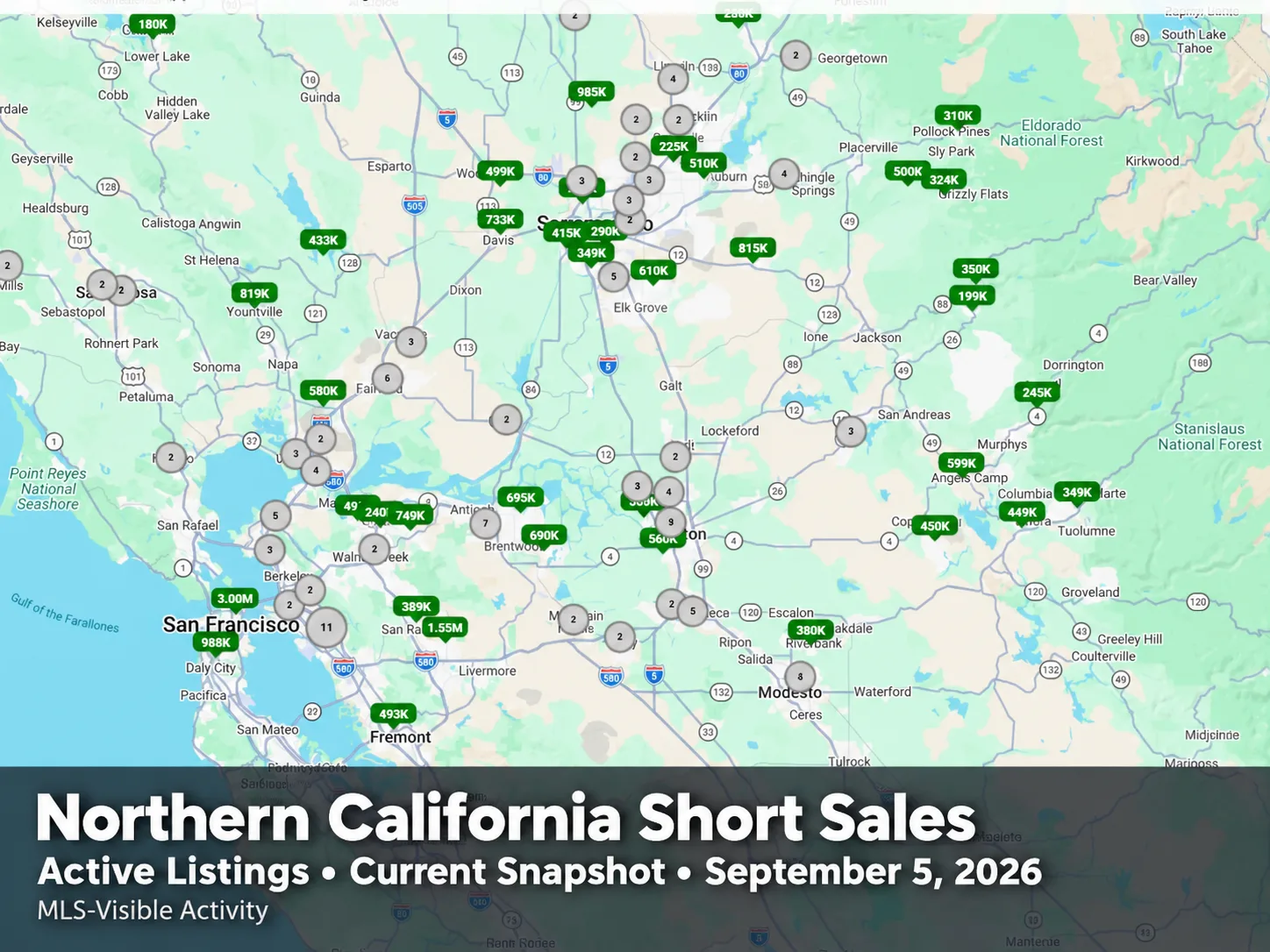
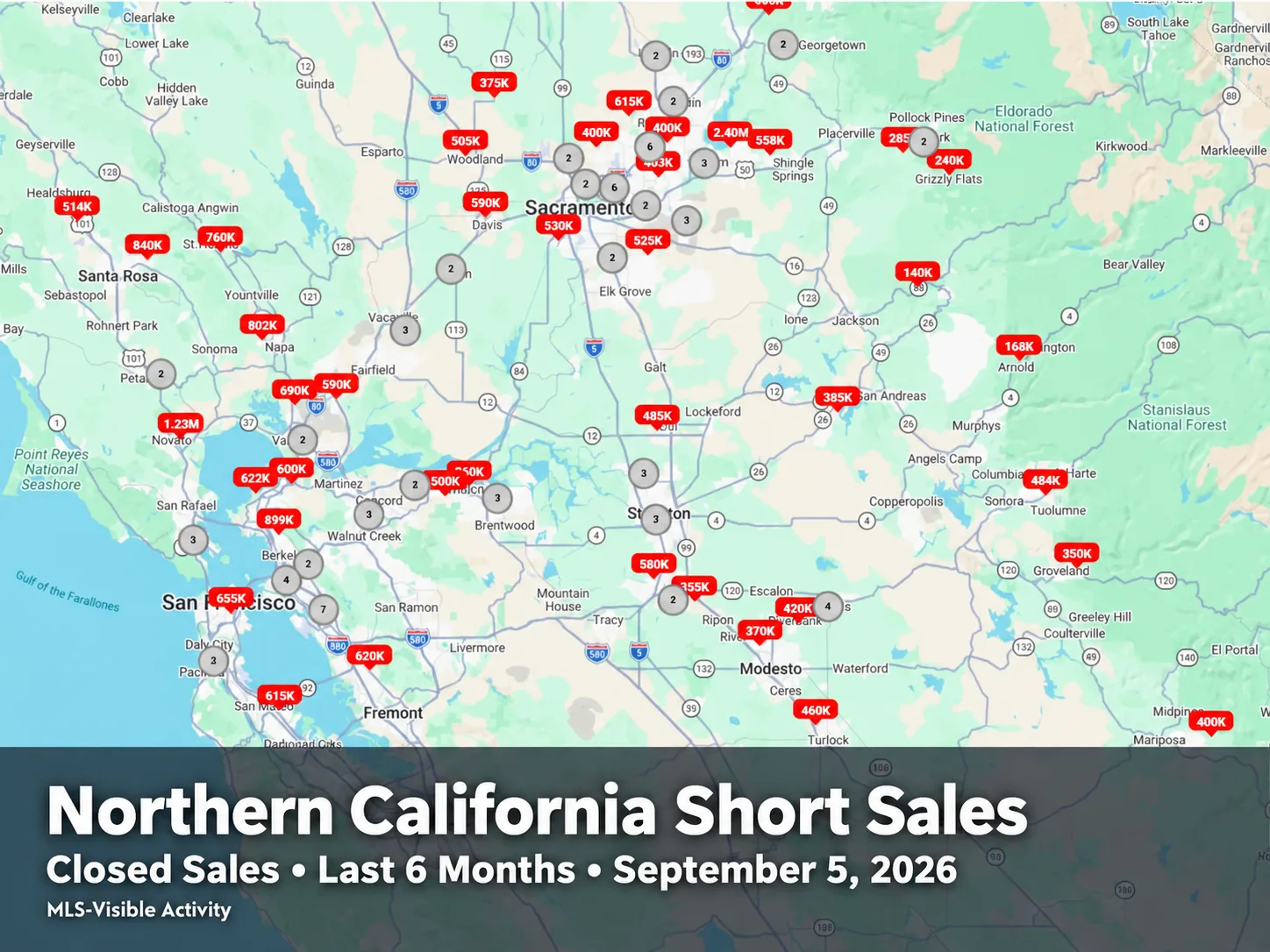
MetroList MLS data reviewed September 5, 2026 shows 183 active residential short sales, 187 already contingent or pending, and 140 completed short sales during the prior six months across the Northern California search area analyzed. If you are struggling with mortgage debt or wondering whether a short sale is still possible, this data shows you are far from alone.
Prepared by the Short Sale Deal Maker team: Gary Lee, McKayla Lee, and Rutsell Lee
Reviewed by The Gary Lee Team. Gary Lee and the team have worked with distressed-property transactions, short sales, lender valuations and REO-related real estate for many years.
A financial hardship can happen in almost any neighborhood and at almost any home value. Job changes, income loss, higher monthly expenses, medical costs, divorce, relocation, second mortgages and other circumstances can leave a homeowner wondering what happens if the home will not sell for enough to cover everything that must be paid. If that sounds familiar, you are not alone.
Northern California currently has a visible, functioning short-sale market. Buyers are putting these homes under contract, lenders are reviewing short-sale transactions, and homeowners are successfully reaching closing. In the MetroList MLS data reviewed September 5, 2026, the Northern California search area analyzed showed 183 active residential short sales, 187 properties contingent or pending, and 140 completed short sales during the prior six months.

Short Sales Are Showing Up Across Northern California
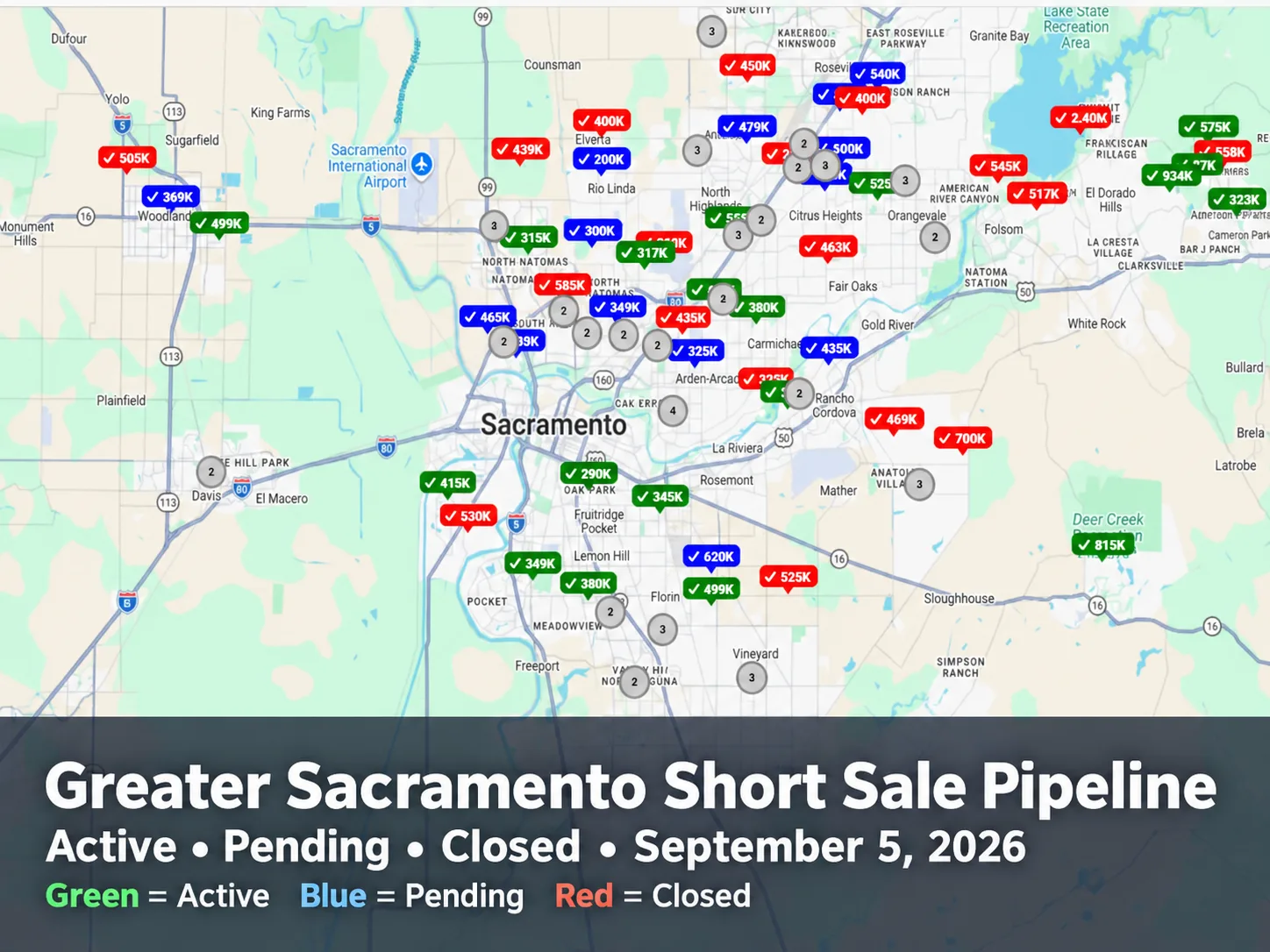
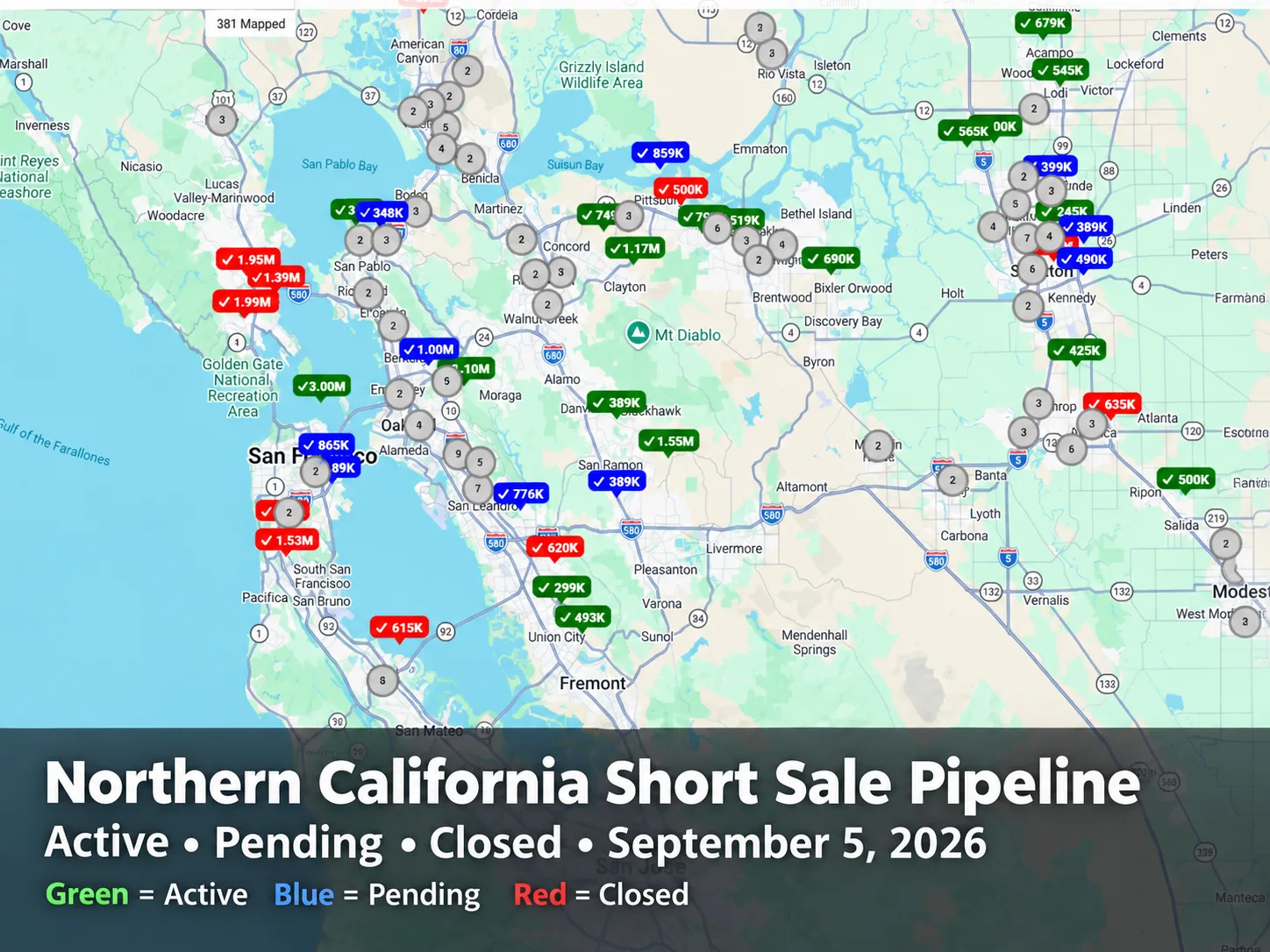
The maps below show MLS-visible short-sale activity throughout the Northern California search area analyzed, including Greater Sacramento, the Central Valley, Solano County and the Bay Area. The purpose of the maps is not to suggest every red or green marker represents the same financial situation. The important point is geographic: short-sale activity is spread across many different communities and price ranges.
The same pattern shows up in communities of many sizes, from Elk Grove, Fairfield and Manteca to Lincoln and the Roseville-Placer region. A short sale is not a single neighborhood story, and it is not limited to one price range.
Where Are Northern California Short Sales Happening?
Some of the clearest clusters are in Sacramento, Stockton, Oakland, Vallejo and Modesto. These numbers do not mean every homeowner in those cities is distressed. They show that short-sale transactions are currently occurring in many very different housing markets, in Sacramento County, San Joaquin County, Alameda County, Solano County and Stanislaus County alike.
| City | Active | Pending | 6-mo Closed | Current pipeline |
|---|---|---|---|---|
| Sacramento | 17 | 16 | 15 | 33 |
| Stockton | 17 | 16 | 6 | 33 |
| Oakland | 14 | 8 | 11 | 22 |
| Vallejo | 8 | 6 | 2 | 14 |
| Modesto | 4 | 10 | 1 | 14 |
Counts of residential short-sale records in the MetroList MLS search area analyzed, reviewed September 5, 2026.
Sacramento Has a Functioning Short-Sale Market
Sacramento is one of the clearest examples in the dataset: 17 active short sales, 16 pending and 15 closed during the six-month period reviewed. The Sacramento closings averaged approximately 80 days on market, with a median of 58 days. That means short sales in Sacramento are not merely being listed. Buyers are purchasing them, and transactions are reaching closing. The activity is not confined to the city itself: Sacramento County and nearby communities such as Elk Grove and Rancho Cordova feed the same market.
Stockton Has a Large Current Pipeline
Stockton also has a current active-plus-pending pipeline of 33, matching Sacramento, but only six short-sale closings appeared in the six-month closed dataset. That difference is worth watching, but the MLS data alone cannot tell us why. Possible factors can include pricing, lender timing, title or lien issues, buyer retention or simply where current transactions are in the approval process.
For homeowners, the takeaway is simple: short-sale timing can vary significantly from property to property. The same pattern can appear in nearby San Joaquin County communities such as Manteca and Tracy.
Short Sales Are Active in the East Bay Too
Oakland recorded 14 active short sales, 8 pending and 11 six-month closings, showing that this is not merely a Sacramento or Central Valley story. Oakland short-sale closings averaged approximately 93 days on market, while the median was only 39 days, another example of why averages alone do not describe every transaction. Alameda County and the surrounding East Bay are part of the picture, not an afterthought.
Not Every Short Sale Takes Forever
The active market is split. 49 active short sales had been on the market fewer than 30 days, while 27 had been listed for 180 days or longer. That is why there is no honest one-size-fits-all answer to "How long does a short sale take?" Timing can be affected by pricing, buyer demand, lender review, multiple liens, title problems, HOA balances, seller documentation and other transaction-specific issues.
- Under 30 days 49
- 30-59 days 36
- 60-89 days 30
- 90-119 days 15
- 120-179 days 26
- 180+ days 27
Count of active short-sale listings in each days-on-market bucket.
Short-Sale Timing Can Vary Dramatically by City and Property
Close-to-list pace varies just as much by city, and averages hide the medians. Citrus Heights, Rancho Cordova and Oakdale each appear with different averages and medians, which is the point: no single city's number describes every property.
| City | Avg DOM to close | Median DOM |
|---|---|---|
| Sacramento | 80 | 58 |
| Oakland | 93 | 39 |
| Citrus Heights | 114 | 109 |
| Stockton | 119 | 72 |
| Oakdale | 56 | 42 |
| Rancho Cordova | 239 | 232 |
Six-month closed dataset by city, MetroList MLS search area analyzed.
The gap between a city's average and its median is a reminder that any single number describes a range of experiences, not any one transaction. A homeowner asking "How long will mine take?" deserves a discussion of their own property, not a city average.
Why One Short Sale May Take Longer Than Another
Several things can affect the timeline:
-
How quickly required seller documents are provided.
-
How many loans or liens are attached to the property.
-
Whether HOA, tax or title issues exist.
-
How the lender's valuation compares with the buyer's offer.
-
Whether the buyer remains committed during lender review.
-
Whether foreclosure deadlines are approaching.
-
Whether additional investor or mortgage-insurance approval is required.
None of these factors is a prediction for any specific home, and no one can promise a short-sale timeline. No promises, only a process that gets reviewed one step at a time.
Short Sales Still Have to Be Priced for the Market
Closed short sales in the six-month dataset sold for approximately 99.4% of their final asking prices, but only about 93.8% of their original asking prices. In other words, successful short sales often finished very close to the price buyers were ultimately willing to support, but many had to adjust from where they first started. A lender's approval is important, but the lender cannot force a buyer to pay more than the market supports.
What Happened From Original Asking Price to Closing?
| Original asking | Final asking | Closed | Close vs final list |
|---|---|---|---|
| 100% | ~94.3% | ~93.8% | ~99.4% |
Six-month closed short-sale dataset. Original asking price is normalized to 100% for comparison.

Short Sales Aren't Just Older Homes
22 of the 183 active short sales, about 1 in 8, were built in 2020 or later, with some built as recently as 2025. That matters because many people still associate short sales with older, neglected properties left over from the last housing crisis. Today's data tells a different story. Financial hardship can affect owners of newer homes too.

Most Short Sales Are in the Middle of the Market. But Not All.
Of the pending short sales, 55% were priced between $300,000 and $499,999, 22% between $500,000 and $749,999, and under 2% above $1 million. Approximately 86% of the six-month closings closed under $750,000.
Yet the data also includes a $2.4 million El Dorado Hills short-sale closing and a $2.995 million active San Francisco short-sale listing. A short sale describes the debt and transaction situation, not the price of the house.
What If You Have a Second Mortgage?
A second mortgage, home-equity loan or HELOC can make a short-sale situation more complicated because more than one lienholder may need to be addressed before the property can transfer clear title. Having a second mortgage does not automatically mean a short sale is impossible. The specific payoff demands, lien positions, investor rules and proposed settlement must be reviewed for the individual property.
For more detail on how junior liens and HELOCs are handled, the junior liens and HELOC guide walks through the key questions.
How Do I Know Whether I May Need a Short Sale?
A short sale is generally considered when the expected proceeds from selling the property may not be enough to satisfy the mortgages, liens and normal selling costs, and one or more lienholders would need to agree to accept less than the full amount otherwise due. Every homeowner's situation is different. Approval requirements can vary by lender, investor, loan type, lien position and homeowner circumstances.
If you want to understand what the process involves before you talk to anyone, the short-sale process guide explains the steps in plain language.
Can I Consider a Short Sale If Foreclosure Has Already Started?
Potentially, but time matters. Listing a home or submitting a short-sale package does not automatically stop a foreclosure sale. Homeowners facing a Notice of Default, Notice of Trustee's Sale or other foreclosure deadline should have the timeline reviewed immediately and should consider appropriate legal or housing-counseling advice as well. The guidance on foreclosure timing during a short sale covers how the two processes interact.
Short Sale FAQs
Are short sales still happening in Northern California?
Yes. The MetroList MLS data reviewed September 5, 2026 showed 183 active residential short sales and 187 properties contingent or pending within the search area analyzed.
Do buyers still buy short sales?
Yes. In this dataset, slightly more short sales were already under contract than actively listed.
How long does a short sale take?
The six-month closed dataset averaged approximately 103 days on market and 135 cumulative days on market. Actual approval and closing timelines vary significantly.
Do short sales sell far below asking price?
Not necessarily. Six-month closed short sales averaged approximately 99.4% of their final asking prices, although they closed roughly 6% below original asking prices on average.
Are short sales only older homes?
No. Approximately 1 in 8 active short sales in this dataset was built in 2020 or later.
Can a million-dollar home be a short sale?
Yes. The dataset included short sales in the seven-figure price range, including a $2.4 million El Dorado Hills closing.
Can I short sell a home with a second mortgage?
Potentially. Second liens must be addressed as part of the transaction, and the requirements vary by lender and investor.
Do I have to already be in foreclosure to do a short sale?
No. A foreclosure filing is not necessarily required before a homeowner explores a short sale.
Does listing a short sale stop foreclosure?
No. Listing a home or submitting a short-sale request does not automatically stop the foreclosure process.
Will the lender automatically approve my short sale?
No. Approval is not guaranteed and depends on the individual lender, investor, loan, lien and homeowner circumstances.
Related reading
- The short sale process, explained for homeowners
- How a short sale is valued
- Junior liens and HELOCs
- Foreclosure timing during a short sale
- Lender and servicer education
- What short-sale fraud is, and what arm's-length means
ShortSaleDealMaker.com publishes short-sale education and market research. The consumer-facing brother site, SacramentoShortSale.com, is where California homeowners can get direct short-sale help. The two sites serve different purposes and are operated by the same real-estate team.
Get Help · No obligation
Request Your Short-Sale Inventory List
Tell Gary where you are looking and what you want to buy, and he will send a verified list of short-sale and REO inventory in your area. A quick note is all it takes.
916-595-4279 Email the team
gary95624@gmail.com
Message received
Thank you. A member of the Short Sale Deal Maker team will review your note and reply as soon as possible.
Something went wrong
We could not send your message. Please try again, or email the team directly at gary95624@gmail.com.