FHA Short Sale Relocation Assistance: What REALTORS Need to Know About the $7,500 Rule
FHA calls a short sale a Pre-Foreclosure Sale, and under HUD Handbook 4000.1 a qualifying owner-occupant borrower may receive up to $7,500 in compensation for relocation or transition assistance. This guide explains the rule, who qualifies, why it is not automatic, and why it is an agent competency issue.
By Gary Lee, REALTOR | Founder and Lead Negotiator, Short Sale Deal Maker | California DRE #01448722
Gary Lee is the founder and lead negotiator of Short Sale Deal Maker and a California-licensed REALTOR since August 2004, with 22+ years of licensed real estate experience and 39 years in full-time sales. He has handled distressed-property work, including short sales, since 2007. He founded SacramentoShortSale.com as his California homeowner-facing short-sale site and works with The Gary Lee Team at eXp Realty of Northern California, Inc.
Behind on an FHA Mortgage: The Question Homeowners and REALTORS Both Need Answered
When a homeowner is behind on an FHA mortgage, the fear is not just losing the house. It is also wondering where they will go next, how they will pay for moving costs, and whether there is any way to leave the situation with dignity. That is a real, human problem, and it is one a REALTOR handling an FHA short sale file inherits the moment the seller asks whether any help exists for what comes next.
In some FHA short sales, HUD allows owner-occupant borrowers to receive up to $7,500 in compensation that may be used for relocation or transition assistance. This is not just a homeowner question. It is an agent competency issue. A REALTOR who does not know the FHA Pre-Foreclosure Sale rules can miss compensation that may be available in the seller’s file, or worse, handle the closing documents incorrectly and lose it.
The Short Answer: Can an FHA Short Sale Seller Receive Up to $7,500?
Yes. In an approved FHA Pre-Foreclosure Sale, HUD allows a qualifying owner-occupant borrower to receive compensation of up to $7,500, and the compensation may be used for relocation or transition assistance. The money is not automatic, not guaranteed, and not available in every short sale. The seller must qualify under FHA/HUD guidelines, and the file must be approved and closed properly. For a REALTOR, that means knowing what FHA calls a short sale, how the compensation is documented, and what the servicer and asset manager must approve before closing.

FHA Calls a Short Sale a Pre-Foreclosure Sale
FHA uses the term Pre-Foreclosure Sale, or PFS. In plain English, that means a short sale where the home sells for less than the total amount owed, and the lienholder agrees to release the lien through the approved process. The Pre-Foreclosure Sale is a loss-mitigation option designed to help borrowers avoid foreclosure and to help reduce the likelihood of an REO/conveyance outcome.
None of this runs on guesswork. The rules come from the FHA Single Family Housing Policy Handbook 4000.1, also referred to as HUD Handbook 4000.1. The handbook governs how an FHA-insured short sale is reviewed, approved, and closed. To see how a short sale works end to end, the short sale process guide walks through the parties, the timeline, and where files stall. The FHA short sale page in the lender and servicer hub summarizes the FHA framework specifically.
What the HUD Handbook Actually Says
The specific rule sits in Section III.A.2.j.iii of the handbook, Pre-Foreclosure Sales, under Subsection G, Owner-Occupant Borrower Compensation. Here is the source citation exactly:
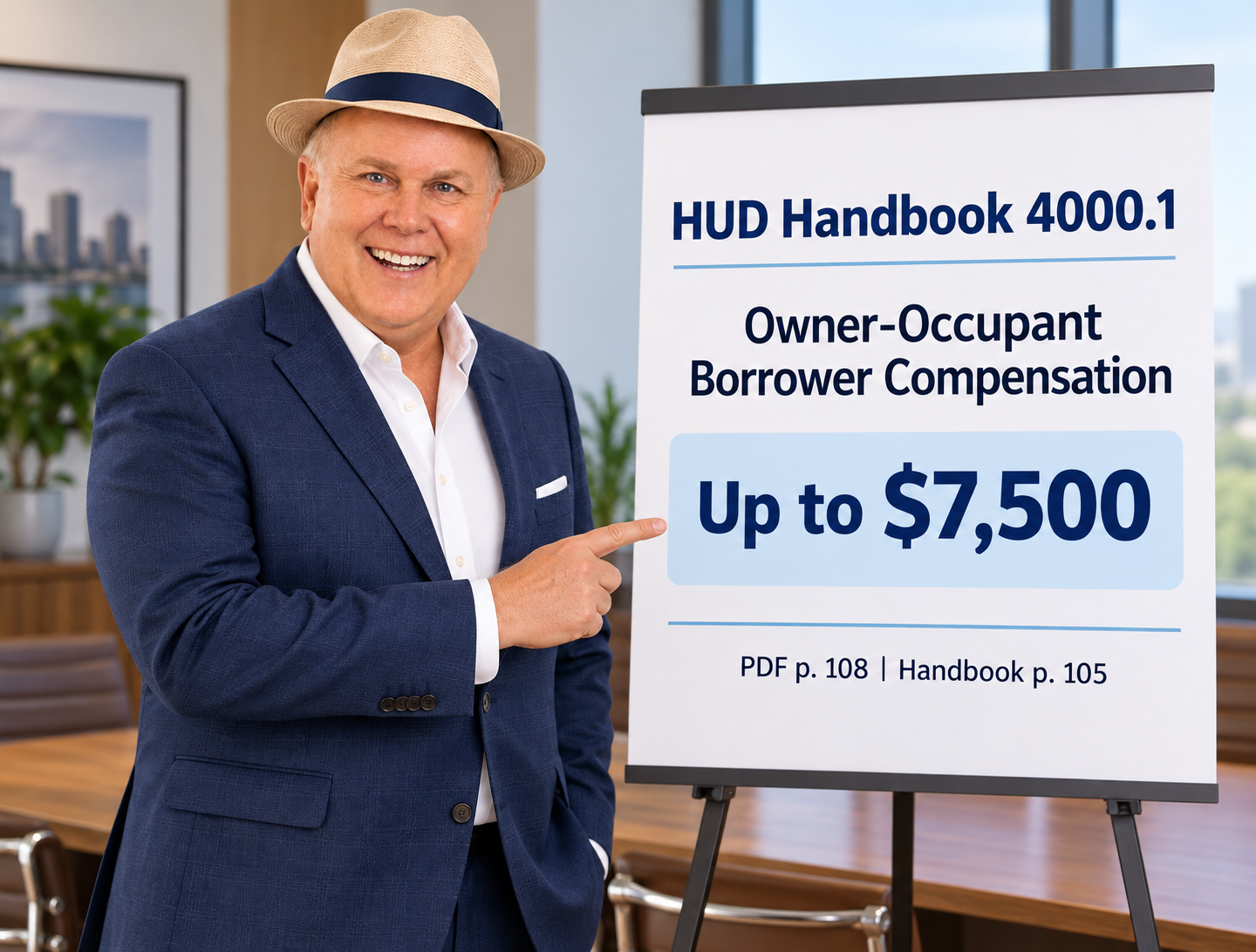
And here is what it says, directly:
“HUD offers Owner-Occupant Borrowers who act in good faith and successfully sell their Properties using the PFS Option a compensation of up to $7,500.”
In plain English: HUD allows up to $7,500 for qualifying owner-occupant borrowers who act in good faith and successfully complete the FHA Pre-Foreclosure Sale short sale process. The phrase “up to” matters. It is a ceiling, not a promise.
Is This Actually Relocation Assistance?
HUD titles the section Owner-Occupant Borrower Compensation, not “relocation assistance.” One of the allowed uses, however, is relocation or transition assistance. The handbook says:
“The Owner-Occupant Borrower may... use the compensation for relocation or transition assistance.”
So the practical answer is yes, in the right file, the money may be used for relocation and transition needs. Depending on how the file is structured and approved, the compensation may help with moving expenses, transition housing costs, deposits, or other approved closing-related needs. The approved use depends on the file: how the servicer and asset manager structure the compensation, what the approval letter says, and how the closing documents reflect it.
Who May Qualify for the $7,500
A seller does not qualify simply by having an FHA loan and being behind on payments. The likely qualifying factors, taken together, are:
-
FHA-insured mortgage
-
Owner-occupant borrower
-
Approved FHA Pre-Foreclosure Sale file
-
Seller acts in good faith
-
Property successfully sells through the approved short sale process
-
Closing documents properly reflect the approved compensation
-
The servicer or asset manager confirms eligibility under HUD rules
Each of these has to line up. The loan must be FHA-insured. The borrower must be an owner-occupant, not an investor. The file must be approved as an FHA Pre-Foreclosure Sale. The seller must act in good faith and actually complete the approved short sale. The closing documents must reflect the approved compensation correctly. And the servicer or asset manager has to confirm eligibility under HUD rules. Miss any one, and the compensation can be reduced, redirected, or lost entirely.
Why Not Everyone Gets the Full $7,500
The $7,500 is not automatic, not guaranteed, and not available in every short sale. The seller must qualify under FHA/HUD guidelines, and the file must be approved and closed properly. Occupancy, loan type, servicer review, title condition, junior liens, PACE obligations, net proceeds, and closing documentation can all affect whether the seller receives the full amount, a reduced amount, or no relocation compensation. Here are the roadblocks that can reduce or redirect the money:
-
PACE obligations: energy loans can eat into the payout.
The compensation may be used to resolve liens, including PACE obligations, so an outstanding Property Assessed Clean Energy balance can reduce or redirect the money before the seller sees a dollar.
-
Junior liens: resolving second mortgages.
Allowable settlement costs include compensation payable to the owner-occupant borrower of $7,500 or to be used to resolve junior liens. A second mortgage or other junior lien can absorb the money before it reaches the seller.
-
Unpaid HOA dues: the association gets paid before the seller relocates.
Unpaid assessments must be settled, and an HOA can be paid ahead of the seller, reducing what reaches the relocation payout.
-
Title issues: clouds that must be cleared.
Title problems can affect what the seller actually receives, and funds meant for relocation can be absorbed resolving them.
-
Net proceeds requirements.
The file must satisfy net proceeds requirements, which can affect whether the seller receives the full amount, a reduced amount, or no relocation compensation.
The handbook addresses this. Allowable settlement costs include compensation payable to the owner-occupant borrower of $7,500 or to be used to resolve junior liens. The handbook also explains that if the owner-occupant borrower receives compensation, that compensation may be applied toward discharging liens.
What that means for a REALTOR: a clean-looking $7,500 can be absorbed by a junior lien, a PACE obligation, an unpaid HOA assessment, or a title problem before the seller sees a dollar. Understanding where the money can go is part of handling the file. The short sale versus foreclosure guide compares the honest trade-offs, and the junior liens guide and title problems guide cover how second liens and title clouds are handled.
Why REALTORS Miss This
The relocation-assistance issue is real, and it gets missed more often than it should. Here is why:
-
The servicer may not volunteer the issue clearly. Relocation compensation is not something a servicer necessarily advertises on a call. It has to be asked about and reviewed.
-
The agent may not know FHA calls a short sale a PFS. If an agent is waiting for the words “short sale” in FHA materials, the Pre-Foreclosure Sale framework can be missed entirely.
-
The compensation may be buried inside the closing numbers. It is easy for $7,500 to disappear into a settlement statement that no one reads line by line.
-
Junior liens or PACE issues may absorb the money. The compensation can be redirected to discharge liens, so the seller’s intended relocation money never reaches them.
-
The Closing Disclosure may not itemize the assistance correctly. If the compensation is not itemized properly, the file can close with the seller receiving nothing documented.
-
The agent may confuse FHA PFS compensation with deed-in-lieu relocation or post-foreclosure cash for keys. These are separate processes with separate rules, and confusing them is a common source of error.
This is why experience matters. The relocation-assistance issue can be missed, misunderstood, or buried in the closing numbers if the person handling the file does not know what to look for. That is exactly the kind of issue Short Sale Deal Maker is designed to help REALTORS catch and handle correctly.
How Short Sale Deal Maker Helps REALTORS Handle FHA Short Sales
Short Sale Deal Maker is a national short sale negotiation platform for REALTORS, with Gary Lee serving as founder and lead negotiator. It helps REALTORS across the country negotiate and complete short sales. Gary works alongside listing agents and brokers nationwide, including REALTORS outside California, providing negotiation support, file strategy, servicer communication guidance, and short-sale process expertise.
When an agent has an FHA short sale file, the support can include:
-
FHA PFS eligibility review
-
Servicer and asset-manager communication
-
Short sale package strategy
-
Relocation assistance questions
-
Junior lien negotiation
-
PACE and title issue strategy
-
Closing Disclosure review
-
Approval letter review
-
Timeline management
-
Avoiding common short sale mistakes
-
Helping agents protect their client and close the file correctly

None of this promises approval. FHA short sale approval is never guaranteed; it depends on the borrower’s situation, the servicer’s review, HUD guidelines, and the file. What Short Sale Deal Maker can do is help an agent catch the issues, ask the right questions, and position the file correctly. The how it works page explains the agent-support model, and the for real estate professionals page lays out the file review, documentation, and valuation support available to listing agents and brokers.
FHA Short Sale vs. Deed-in-Lieu: Know the Difference
HUD also discusses relocation assistance for deed-in-lieu transactions, but that is a separate process from a short sale. A deed in lieu transfers the property back to the lender through a negotiated agreement, while a Pre-Foreclosure Sale sells the property to a third-party buyer through the approved short sale process.
The deed-in-lieu relocation assistance rule appears separately in HUD Handbook 4000.1, Section III.A.2.j.iv(D). It should not be confused with FHA PFS owner-occupant borrower compensation, and neither should post-foreclosure cash for keys. This article focuses mainly on FHA short sales, or Pre-Foreclosure Sales. The short sale versus foreclosure guide covers the broader comparison for sellers weighing their options.
California Homeowners: Gary Can Help Directly
If the property is in California, Gary Lee can work directly with the homeowner through SacramentoShortSale.com. Gary is a licensed California REALTOR with short sale and foreclosure experience dating back to 2007, and he handles California short sale representation through The Gary Lee Team at eXp Realty of Northern California, Inc. California homeowners can review whether a short sale may help avoid foreclosure and whether FHA relocation assistance should be evaluated in the file.
Homeowners who are not sure where to start can use the do you actually need a short sale path, and the what can stop a foreclosure guide maps the legitimate options. California agents with a looming trustee sale can also review the AB 2424 trustee sale postponement guide . Anyone working a file should also review the short sale fraud and arm’s-length rules to keep every file above board.
FHA Short Sale Relocation Assistance FAQs
Can an FHA short sale seller receive up to $7,500 in relocation assistance?
In an approved FHA Pre-Foreclosure Sale, HUD allows a qualifying owner-occupant borrower to receive compensation of up to $7,500 under HUD Handbook 4000.1. The money is not automatic, not guaranteed, and not available in every short sale. The seller must qualify under FHA/HUD guidelines, and the file must be approved and closed properly.
What does FHA call a short sale?
FHA calls its foreclosure-avoidance short sale a Pre-Foreclosure Sale, or PFS. In plain English, it is a short sale where the home sells for less than the total amount owed and the lienholder agrees to release the lien through the approved FHA process. The rules come from HUD Handbook 4000.1, not from guesswork.
Can the $7,500 be used for relocation or moving expenses?
Yes. HUD states that the owner-occupant borrower may use the compensation for relocation or transition assistance. Depending on how the file is structured and approved, the funds may help with moving expenses, transition housing costs, deposits, or other approved closing-related needs.
Why might a seller not receive the full $7,500?
The $7,500 is not automatic. It can be reduced or redirected depending on the file. It may be used to resolve liens, including PACE obligations, or to cover certain transaction costs not paid by HUD. Junior liens, unpaid assessments, title problems, and net proceeds requirements can all affect what the seller actually receives.
Is FHA owner-occupant borrower compensation the same as deed-in-lieu relocation assistance?
No. HUD also discusses relocation assistance for deed-in-lieu transactions, but that is a separate process from a short sale. FHA PFS owner-occupant borrower compensation is a distinct rule under HUD Handbook 4000.1, Section III.A.2.j.iii(G), and should not be confused with deed-in-lieu relocation or post-foreclosure cash for keys.
Who decides whether an FHA short sale seller receives relocation compensation?
The servicer or asset manager must review and approve the file under HUD guidelines. Closing documents must properly reflect the approved compensation, and the seller must act in good faith and successfully complete the approved Pre-Foreclosure Sale process. Each factor is confirmed as part of the servicer and asset manager review.
Last reviewed and updated: September 2026