Received a Notice of Default in Sacramento? What You Can Still Do Before a Trustee Sale
A California Notice of Default does not transfer ownership, and it does not mean your home has already been sold. If you have received a Notice of Default or a Notice of Trustee's Sale in Sacramento, you may still have time to pursue reinstatement, a loan-retention option, a traditional sale, a short sale, a deed in lieu, or appropriate legal or bankruptcy advice. What is still possible depends on your equity, your loan status, servicer review, and the actual foreclosure deadline on your recorded notices.
By Gary Lee, REALTOR | Founder and Lead Short Sale Negotiator | California DRE #01448722
Gary Lee has worked with distressed homeowners since 2007, has been a licensed California REALTOR for more than 20 years, completed CDPE coursework in 2009, and founded both SacramentoShortSale.com and ShortSaleDealMaker.com.
The Short Answer: A Notice of Default Is Not the End
No. A California Notice of Default does not transfer ownership, and it does not mean the home has already been sold. If you received a Notice of Default or a Notice of Trustee's Sale, you may still have time to pursue reinstatement, a loan-retention option, a traditional sale, a short sale, a deed in lieu, or appropriate legal or bankruptcy advice. What is actually possible depends on your equity, your loan status, the servicer's review, and the real foreclosure deadline on your recorded notices.
I have worked with homeowners in mortgage default since 2007, and the single most common mistake I see is reading a Notice of Default as a finish line. It is not. It is the start of a defined, time-sensitive process. In California that process usually leaves room to act, but only if you act early and with accurate information about your dates and your numbers.
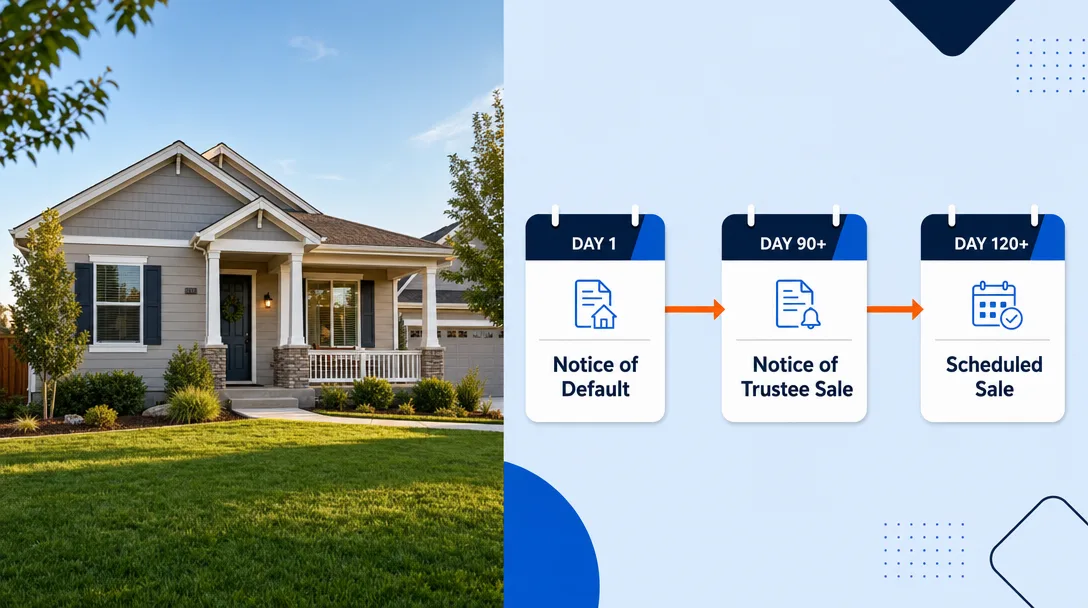
Notice of Default Versus Notice of Trustee's Sale
In California, most mortgages are foreclosed outside of court under a power of sale written into the deed of trust. Two documents carry most of the public timeline.
Notice of Default. This is the first public step. The lender or its servicer records it with the county when you are in default, usually meaning you are behind on payments. It tells the public, and it tells you, that the loan is in default and that foreclosure has started. It does not hand ownership of the home to anyone.
Notice of Trustee's Sale. This is the auction notice. In a typical California nonjudicial foreclosure, at least about three months must pass after the Notice of Default before the Notice of Trustee's Sale can be given, and the sale itself is scheduled no sooner than about 20 days after that notice. The Notice of Trustee's Sale names a specific date, time, and location for the auction.
So the difference matters. The Notice of Default says the process has begun. The Notice of Trustee's Sale says a specific sale date now exists. For a deeper look at how a scheduled sale can be postponed under California law, see our guide on AB 2424 and trustee-sale postponement in California .
Being Behind Versus Having an Auction Date
Being behind on payments and having an auction date are two very different situations, and they deserve different responses.
If you are simply behind, you generally have more room. You may still be able to catch up, request a loan modification, work out a repayment plan, or pursue a sale before a sale date is ever scheduled. The goal at this stage is to act before the calendar tightens.
Once a Notice of Trustee's Sale has been recorded and an auction date is set, the calendar becomes the controlling fact. Every option now has to be measured against that date. That does not mean the sale will happen on that date. Auctions get postponed for many reasons. It means you can no longer treat time as unlimited.
The honest way to look at this: the farther along you are, the fewer open-ended strategies remain, and the more coordination matters. That is why I tell homeowners to pull the actual dates off their recorded notices and work backward from there. The guide on how foreclosure timing interacts with a short sale walks through how the two processes run side by side.
Evaluate a Traditional Equity Sale Before Assuming a Short Sale Is Necessary
A short sale is not automatically the right answer just because you are in foreclosure. Before anyone labels your situation a short sale, the numbers need to be checked.
A traditional sale works when the expected sale price, after normal selling costs, is enough to pay off every mortgage and lien that must be cleared to deliver title. If the numbers work, a regular sale may be the cleaner path, even under a tight deadline.
A short sale only becomes necessary when the expected net proceeds are not enough to satisfy what must be paid, and one or more lienholders agree to accept less than the full amount. The test is the net proceeds, not the sticker price, and not a website's automated value estimate.
So the first calculation is simple on paper: expected sale price, minus estimated selling expenses, minus the payoffs of every mortgage and lien, equals either proceeds or a shortage. A qualified agent with local knowledge and real comparable sales can help you run that with accurate numbers. Start in the Short Sale Knowledge Center , which collects the original, reviewed guides that answer this question step by step.
How a Short Sale Fits Into the Foreclosure Timeline
If the numbers point to a short sale, the foreclosure timeline becomes part of the transaction. A short sale is a real estate sale plus a lender-approval process running side by side. The sale has to get a buyer under contract. The lender has to review the file and approve a payoff. Both have to finish before the trustee-sale date, unless that date moves.
That is why the timeline matters so much. A well-prepared short-sale file can be positioned to reach approval, but the foreclosure clock does not pause just because a short sale has been requested. The short-sale process guide explains each phase and where files tend to stall, which is exactly the information a homeowner needs when a sale date is approaching.
In California, a homeowner facing a scheduled sale still has statutory tools worth understanding, including the one below. But those tools are conditional, they have strict requirements, and they buy time. They do not close the transaction for you.
What AB 2424 May Provide
California AB 2424 added a provision to Civil Code Section 2924f that can matter to a homeowner with a scheduled trustee sale. Please read this carefully, because the most common description of this law online is simply wrong.
AB 2424 does not give every California homeowner an automatic 90-day extension. That is not what the law says.
For qualifying California residential property containing one to four dwelling units, timely delivery of a qualifying listing agreement to the required parties may require the foreclosure sale to be postponed for at least 45 days following the scheduled sale date. If the first postponement was properly obtained, timely delivery of a qualifying purchase agreement may require the sale to be postponed to a date at least 45 days after the trustee receives the purchase agreement.
The word to hold onto is qualifying. The postponement is conditional. It only applies when the statute's requirements are actually met, and meeting them is a matter of exact timing and documentation, not good intentions.
The Exact AB 2424 Delivery and Timing Requirements
Because every element matters, here are the specifics in plain language:
-
Qualifying property. The law covers California residential real property containing no more than four dwelling units, sold through a nonjudicial foreclosure under a power of sale in a deed of trust or mortgage.
-
Qualifying listing. There must be a listing agreement signed by the homeowner with a California-licensed real estate broker, and the property must be genuinely marketed to the public, such as on a multiple listing service.
-
Five-business-day timing. The trustee must receive the required documentation at least five business days before the scheduled sale date. Five business days is the legal minimum, not a comfortable margin.
-
Required delivery recipients. The documentation must be delivered on time to the required parties, including the trustee. Each postponement opportunity has its own statutory delivery requirements.
-
Tracked delivery and proof of receipt. Delivery must be by certified mail or a qualifying overnight courier, with tracking that confirms receipt, including the date and time. Your proof of receipt is your evidence that the requirement was met.
-
Each postponement has conditions. The listing postponement and the purchase-agreement postponement are separate opportunities, and each has statutory conditions. They are not automatic, and the transaction is not guaranteed to close.
-
A REALTOR's role. A real estate professional can help you understand and prepare the real-estate side of this process, but a REALTOR should not give you legal advice about statutory compliance. That is a question for an attorney.
For the full walkthrough of what the law allows and what it does not, read Can a REALTOR Stop a Trustee Sale in California? What AB 2424 Actually Allows .
Why Signing a Listing Agreement Does Not Automatically Stop a Sale
This is where a lot of homeowners get hurt by a well-meaning but wrong promise. Signing a listing agreement, by itself, does not stop a trustee sale. Not under AB 2424, and not under any other routine California rule.
The AB 2424 postponement only works when the qualifying listing is genuinely in place with a California-licensed broker, the property is actually being marketed to the public, the required documentation reaches the trustee at least five business days before the sale, and delivery is tracked and verifiable. Miss one requirement, and the postponement may not apply.
And even when the postponement applies, it does not stop foreclosure permanently. It changes the sale date. The mortgage default, the lien, and the foreclosure proceeding remain. What the extra time is worth depends entirely on what you do with it, and there is no guarantee the transaction closes.
What Documents You Should Gather Immediately
Whether the goal is reinstatement, a loan modification, a traditional sale, or a short sale, the paperwork is largely the same. Start collecting these now:
-
Your mortgage statement and any second mortgage or HELOC statements.
-
Payoff statements or payoff estimates for every loan.
-
The Notice of Default and the Notice of Trustee's Sale, with their dates.
-
Property tax bills and any tax liens.
-
HOA statements, including delinquent assessments and transfer or document fees.
-
Any judgments, child-support or spousal-support liens, or other recorded liens.
-
Solar contract or PACE assessment documents, if they apply.
-
Two years of tax returns, recent pay stubs, bank statements, and a hardship letter if you will pursue a short sale or loan modification.
The more complete this package is, the faster an experienced agent or servicer can evaluate your options against the clock.
What the REALTOR Can Do
A qualified real estate professional cannot stop a foreclosure by wishing it away, and no honest agent will promise that. What an experienced agent can do is concrete and valuable:
-
Pull comparable sales and build a defensible value opinion for the property.
-
Help you decide whether a traditional sale or a short sale fits the numbers.
-
List and market the property to real buyers.
-
Prepare the real-estate side of an AB 2424 request, including documentation and tracked delivery, and coordinate with the trustee.
-
Communicate with the servicer and push the file through lender review.
-
Keep every deadline on a single calendar and flag what is coming next.
If you are a California homeowner considering direct representation, learn more about California short-sale representation through The Gary Lee Team .
What Requires an Attorney, Tax Professional, HUD Counselor, or Bankruptcy Professional
Real estate brokerage handles the sale. Some things sit outside that lane, and the right professional matters:
-
An attorney for legal questions about the foreclosure itself, statutory compliance, personal liability, or any legal challenge.
-
A tax professional for questions about forgiven debt, which can raise separate tax-reporting questions such as a possible 1099-C.
-
A HUD-approved housing counselor for free help understanding loss-mitigation options and foreclosure counseling.
-
A bankruptcy professional, which means an attorney, for questions about whether bankruptcy may pause or restructure things. Bankruptcy is a legal decision with serious and lasting consequences, not a casual option.
Gary Lee and the Short Sale Deal Maker team provide real-estate information and short-sale transaction coordination. They are not attorneys, CPAs, tax professionals, bankruptcy professionals, or credit-repair providers.
A "Do Not Wait" Checklist for Homeowners With an Actual Sale Date
If you already have a trustee-sale date, work this list now. Every item is something you can start today:
- 1
Pull the actual dates off your recorded Notice of Default and Notice of Trustee's Sale. Work backward from the sale date.
- 2
Get a current value opinion from an experienced local agent, not an automated estimate alone.
- 3
Ask your servicer where your file stands in loss mitigation and whether a short-sale or loan-retention review is possible.
- 4
Collect the documents in the list above.
- 5
If a short sale fits the numbers, get it listed and under contract early enough to matter.
- 6
If you believe AB 2424 could apply, have a California-licensed broker prepare the real-estate side now, not on the fifth business day.
- 7
Confirm delivery requirements with the trustee and keep your tracking and proof of receipt.
- 8
Talk to the right professionals for the parts outside real estate: attorney, tax, HUD counselor, or bankruptcy professional.
- 9
Do not stop making payments based on an internet article. Stopping payments has real consequences, and the choice should be made with advice, not by default.
- 10
Keep every deadline on one calendar and check it daily.
- 11
If a sale date is close, do not wait for a buyer or an approval to fall into place. Keep the process moving every single day.
Notice of Default FAQs
Is it already too late to sell after receiving a Notice of Default in California?
No. A California Notice of Default does not transfer ownership and does not mean the home has already been sold. You may still have time to pursue reinstatement, a loan-retention option, a traditional sale, a short sale, a deed in lieu, or appropriate legal or bankruptcy advice. What is actually possible depends on your equity, loan status, servicer review, and the real foreclosure deadline on your recorded notices.
What is the difference between a Notice of Default and a Notice of Trustee’s Sale?
The Notice of Default is the first public step in a California nonjudicial foreclosure. It records that the loan is in default and starts the process. The Notice of Trustee’s Sale, recorded later, announces a specific auction date, time, and location for the property. One says the process has begun. The other says a sale date now exists.
How much time is there between a Notice of Default and a trustee sale in California?
In a typical California nonjudicial foreclosure, at least about three months must pass after the Notice of Default before the Notice of Trustee’s Sale can be given, and the sale is scheduled no sooner than about 20 days after that notice. The exact dates on your recorded notices control your property, not a general rule.
Does AB 2424 automatically give homeowners a 90-day extension?
No. California AB 2424, reflected in Civil Code Section 2924f, does not create an automatic 90-day extension. For qualifying California residential property containing one to four dwelling units, timely delivery of a qualifying listing agreement to the required parties may require the foreclosure sale to be postponed for at least 45 days following the scheduled sale date. Each postponement opportunity has statutory conditions.
Does signing a listing agreement automatically stop a trustee sale?
No. Merely signing a listing agreement does not automatically stop a sale. The AB 2424 postponement requires a qualifying listing with a California-licensed broker, real public marketing, timely delivery of required documentation to the trustee at least five business days before the sale, and tracked delivery that confirms receipt.
Can I do a traditional sale after a Notice of Default, or do I need a short sale?
It depends on whether the expected net proceeds are enough to pay the mortgages, liens, and selling costs. A traditional equity sale must be evaluated before assuming a short sale is necessary. If the expected proceeds are not enough to cover everything that must be paid at closing, a short sale may be worth exploring.
What should I do first if my trustee sale date is close?
Gather your documents and get your actual dates reviewed immediately. Pull the mortgage statements, payoff estimates, property taxes, HOA statements, any second mortgage or HELOC, recorded judgments, and the Notice of Default and Notice of Trustee’s Sale. Have a qualified real estate professional review the timeline, and get appropriate legal, tax, or housing-counseling advice for the parts outside real estate. Do not wait until the five-business-day edge of a statutory deadline.
Last reviewed and updated: September 2026