Can a Properly Trained Short Sale REALTOR® Help Postpone a California Trustee Sale?
How AB 2424, documentation, short sale strategy, and servicer communication may create time for a homeowner to sell before foreclosure.
By Gary Lee, REALTOR® | Founder and Lead Short Sale Negotiator | California DRE #01448722
Gary Lee has worked with distressed-property situations since 2007, including short-sale work, more than 100 REO listings, BPO and valuation experience, foreclosure-related transactions, and lender-facing transactions. He founded SacramentoShortSale.com and ShortSaleDealMaker.com.
When a California homeowner receives a trustee sale date, time becomes the enemy. The question is not whether a REALTOR® can wave a magic wand and stop foreclosure. The real question is whether a properly trained short sale REALTOR® can help create and document a serious sale effort quickly enough to support a postponement and give the property time to sell.
The Short Answer: Yes, in Some Situations, With No Guarantee
Yes, in some situations, a properly trained California short sale REALTOR® may help a homeowner pursue a trustee-sale postponement by building the sale-side file, documenting market activity, working with the servicer, and helping determine whether California protections such as AB 2424 may apply.
But no result is guaranteed. A REALTOR® does not personally control the trustee sale, does not issue a legal stay, and is not acting as a foreclosure defense attorney. The honest framing is that a properly trained short sale REALTOR® may help create the documentation, communication, offer activity, and servicer review needed to support a trustee-sale postponement request, especially when the file is handled early enough and the facts qualify. AB 2424 adds another California-specific layer because certain eligible owner-occupants may have postponement rights tied to listing the property and pursuing a sale, but it is not automatic and must be handled correctly.
For the broader picture of what can and cannot stop or pause a foreclosure, read our guide to what can stop a foreclosure , and for the statutory detail behind AB 2424, see Can a REALTOR® Stop a Trustee Sale in California? .
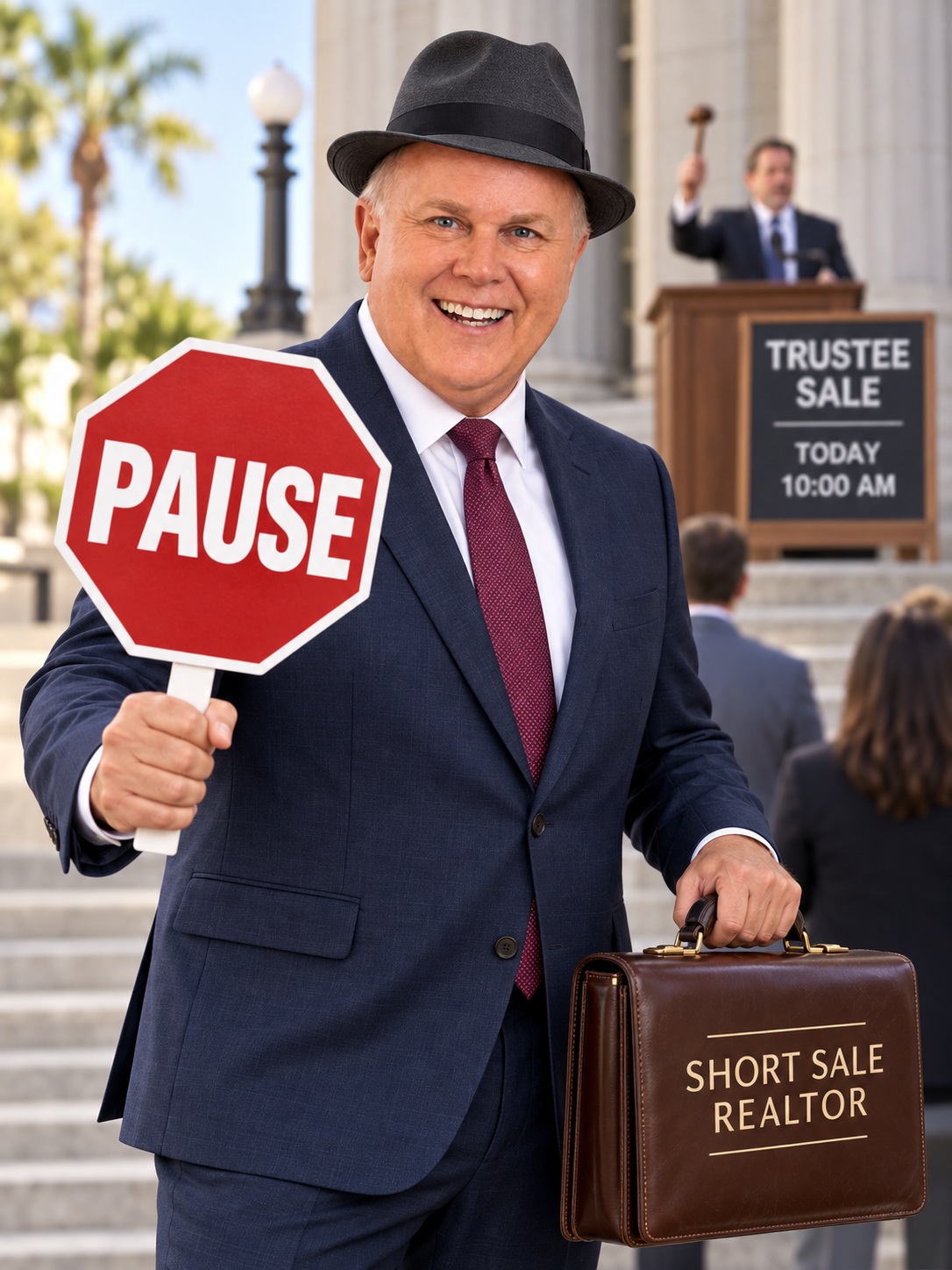
What a Short Sale REALTOR® Can and Cannot Do
Start with the boundary: a REALTOR® does not personally control the trustee sale, does not issue a legal stay, and is not acting as a foreclosure defense attorney. Within that boundary, a properly trained short sale REALTOR® can do a great deal on the real estate side.
Can do
-
List the home
-
Prepare pricing strategy
-
Market the property
-
Generate and submit offers
-
Prepare the short sale package
-
Communicate with servicer / asset manager
-
Coordinate title and escrow
-
Help document sale efforts
Cannot do
-
Give legal advice
-
Act as foreclosure defense counsel
-
Guarantee postponement
-
Force the trustee to delay
-
Guarantee short sale approval
-
Guarantee deficiency or tax treatment
In plain terms: the REALTOR® may help support a postponement request, may help create time for a sale when the facts qualify, can help document that the property is actively listed and being marketed, can help coordinate the sale-side file for servicer review, and can help the homeowner pursue available sale-related postponement options. That work does not replace legal advice.
Why AB 2424 Matters
AB 2424 is one of the most important California foreclosure updates for homeowners trying to sell before foreclosure, and it is worth citing directly from the official sources.
AB 2424 amended California Civil Code section 2924f. It was signed into law in September 2024 and became effective January 1, 2025, applying to notices of default filed on or after that date and covering owner-occupied one-to-four unit residential properties. It does not apply to commercial property or to buildings of five or more units.
The source of record is the official California statute and bill material: AB 2424 bill text on California Legislative Information , the current text of California Civil Code section 2924f , which AB 2424 amended, and California Civil Code section 2924g , which covers trustee-sale postponement procedure.
Where the borrower is attempting to sell, the statute sets out two sale-related postponement provisions:
The 45-Day Listing Agreement Postponement
-
Trigger: the trustee receives, at least five business days before the scheduled sale date, a bona fide listing agreement for the property with a California-licensed real estate broker, for a publicly available listing reflecting a genuine effort to sell at or above the outstanding loan balance.
-
Effect: the foreclosure sale may not be conducted until the expiration of 45 days.
The 45-Day Purchase Agreement Postponement
-
Availability: only if a scheduled date of sale has already been postponed under the listing-agreement provision.
-
Trigger: the trustee receives, at least five business days before the newly scheduled sale date, a copy of a valid purchase agreement for the property.
-
Effect: the trustee must postpone the sale to at least 45 days after the day the purchase agreement was entered into.
Read that carefully: this is a 45-day listing-agreement postponement right, not a "90-day" guarantee and not an automatic stop. It is conditional and process-based. It requires a real listing with a licensed California broker, genuine marketing, timely delivery of the documentation, and a sale effort that is real. The purchase-agreement provision does not apply on its own; it is available only after a scheduled sale date has already been postponed under the listing-agreement provision. The law buys time so the property can sell; it does not close the transaction for anyone, and it is not a guarantee that the sale happens.
The exact deadline, documentation, and postponement period should be verified against current California Civil Code section 2924f and the facts of the file, and a California attorney should review any specific situation.

For the full statutory walkthrough of what AB 2424 actually allows and what it does not, read Can a REALTOR® Stop a Trustee Sale in California? What AB 2424 Actually Allows .
The Documentation Problem
A homeowner saying "I’m trying to sell" is weak. A properly built file is what supports a postponement request, and this is where an experienced short sale REALTOR® earns their place. A properly built file may include:
-
Signed listing agreement
-
MLS listing proof
-
Pricing support / CMA
-
Showing activity
-
Offer history
-
Executed purchase contract, if available
-
Short sale package
-
Third-party authorization
-
Preliminary title report
-
Escrow contact
-
Servicer communication log
-
Evidence the sale is real, not fake delay tactics
The point of every item is the same: evidence the sale is real. The servicer and trustee are looking for proof that the sale is real, not a delay tactic, and a properly trained short sale REALTOR® builds the file with verified MLS listing data and documented buyer activity so the request is backed by evidence. For the full item-by-item breakdown of what belongs in the file, see the short sale documentation guide and the short sale process guide .
Why Timing Matters
Waiting until the last few days is dangerous. Some postponement options require time, documentation, review, and communication. The earlier a short sale REALTOR® is involved, the better the chance of building a credible file.
The five-business-day submission window in AB 2424 is the legal minimum, not a comfortable margin. If a homeowner waits until the final week before a trustee sale, there may simply not be enough time to assemble the listing, complete the package, get it delivered and tracked, and give the servicer room to review. A homeowner should not wait until the final days before the trustee sale to start.

If you are not sure what a short sale is or whether one fits your numbers, start with the Need a Short Sale? guide . If you are comparing the foreclosure path against a short sale, the short sale vs. foreclosure guide lays out the honest trade-offs, and the foreclosure timing guide explains how the two processes run side by side when a sale date exists.
How Gary Helps California Homeowners
Gary can help California homeowners through SacramentoShortSale.com because he is a licensed California REALTOR®.
Gary does not act as an attorney. He does not promise to stop foreclosure. His job is to handle the real estate side with urgency, accuracy, and experience so the homeowner has the strongest sale-side file possible. That means getting the property listed, pricing it credibly, generating buyer activity, building the short sale package, communicating with the servicer, coordinating with title and escrow, and documenting that a sale is being actively pursued.
How Short Sale Deal Maker Helps REALTORS® Nationally
For agents in California or outside California, Short Sale Deal Maker helps REALTORS® understand how to build the short sale file, communicate with servicers, prepare documentation, and avoid common mistakes that can cost the seller time. This is national transaction-support information that works alongside the rules of the state where the property sits.
If you are a REALTOR® carrying a file with a trustee sale date, the new short sale listing checklist , the short sale file review checklist , and the short sale approval letter guide cover the real steps that keep a file moving, and the For Real Estate Professionals section explains the negotiation and transaction support available.
California Trustee Sale Postponement FAQs
Can a properly trained short sale REALTOR postpone a California trustee sale?
In some situations, yes. A properly trained California short sale REALTOR may help a homeowner pursue a trustee-sale postponement by building the sale-side file, documenting market activity, working with the servicer, and helping determine whether California protections such as AB 2424 may apply. But no result is guaranteed. A REALTOR does not personally control the trustee sale, does not issue a legal stay, and is not acting as a foreclosure defense attorney.
Does AB 2424 apply to every property and every borrower in California?
No. AB 2424 is California-specific, it does not apply to every property or every borrower, and it is not the same thing as a guaranteed foreclosure stop. It applies to owner-occupied one-to-four unit residential properties, and it can create postponement rights only in certain qualified situations tied to real sale efforts and documentation.
What does AB 2424 require for a listing-based postponement of a trustee sale?
If the trustee receives, at least five business days before the scheduled date of sale, a listing agreement for the property from the mortgagor or trustor that is with a California-licensed real estate broker, is for a publicly available listing, and reflects a bona fide effort to sell at or above the outstanding loan balance, the foreclosure sale may not be conducted until the expiration of 45 days. A separate purchase-agreement provision is conditional: it applies only when a scheduled date of sale has already been postponed under the listing-agreement provision and the trustee receives a copy of a purchase agreement at least five business days before the scheduled postponed date of sale, in which case the trustee must postpone the sale to at least 45 days after the day the purchase agreement was entered into. These are conditional, process-based rights, never automatic and never a guaranteed stop.
When did AB 2424 take effect in California?
AB 2424 amended California Civil Code section 2924f. It was signed into law in September 2024 and became effective January 1, 2025, applying to notices of default filed on or after that date.
What documentation shows that a sale effort is real?
A properly built file may include a signed listing agreement, MLS listing proof, pricing support or CMA, showing activity, offer history, an executed purchase contract if available, the short sale package, third-party authorization, a preliminary title report, escrow contact, a servicer communication log, and evidence the sale is real rather than delay tactics.
What can a short sale REALTOR do to help when a trustee sale date exists?
A properly trained short sale REALTOR may help get the property listed quickly, prepare a credible market valuation, generate buyer activity, obtain a signed purchase contract, build the short sale package, communicate with the servicer, coordinate with the title and escrow company, document that a sale is being actively pursued, and identify whether AB 2424 timing may matter. These actions may help support a postponement request when the facts qualify. They do not replace legal advice.
Can a REALTOR guarantee a postponement, short sale approval, or tax outcome?
No. A REALTOR cannot guarantee a postponement, cannot force the trustee to delay, and cannot guarantee short sale approval, deficiency treatment, or tax treatment. A REALTOR should not give legal advice or act as foreclosure defense counsel. Each outcome depends on the facts, the servicer, and the requirements that apply to the specific file.
How does Short Sale Deal Maker help REALTORS nationally with short sales?
Short Sale Deal Maker helps REALTORS understand how to build the short sale file, communicate with servicers, prepare documentation, and avoid common mistakes that can cost the seller time. AB 2424 is California-specific, but the sale-side strategy and transaction-support information apply nationwide.
Last reviewed and updated: September 2026
Every file is handled as if it were the team’s own home on the line, and every client relationship is treated as a trust, not a transaction, especially during the most stressful moment of a homeowner’s journey.